The Complex Equation of School Holidays for Geneva Parents
It is December 23, 2025. As the year slowly draws to a close, a familiar concern is already looming on the horizon for many households: organizing the upcoming holidays. For active parents living in Geneva, managing school breaks often feels like a true organizational feat. Between work obligations that do not stop and the vital need to offer quality moments to one's offspring, the balance is fragile.
The situation becomes particularly dilemmatic when the family grows. Having several children of different ages often means managing divergent interests, distinct biological rhythms, and, too often, multiple drop-off locations. The classic holiday morning scenario looks like a race against the clock: dropping the youngest at sport, the eldest at their music course, all while trying to arrive at the office on time. This fragmentation of activities generates a considerable mental load, transforming what should be a period of relaxation into a source of extra stress.
This is where the necessity for a centralized solution comes in. Finding a school or a structure capable of welcoming all siblings, from 4 to 16 years old, on a single site, is not just a logistical comfort: it is a survival strategy for adults and a guarantee of emotional security for the little ones. Knowing that one's big brother or big sister is in the same building, even if they are not participating in the same camp, reassures the child and drastically simplifies the lives of parents.
A Pedagogy Adapted to Each Age: Understanding Specific Needs
Beyond the practical aspect, the choice of a camp must respond to precise pedagogical imperatives. A 4-year-old child does not have the same developmental needs as a 15-year-old adolescent. An excellent structure in Geneva distinguishes itself by its ability to segment its offers while maintaining a coherent educational philosophy, centered on emotional fulfillment and benevolent learning.
Awakening for 4-7 Year Olds: More than Daycare, an Education in Sensitivity
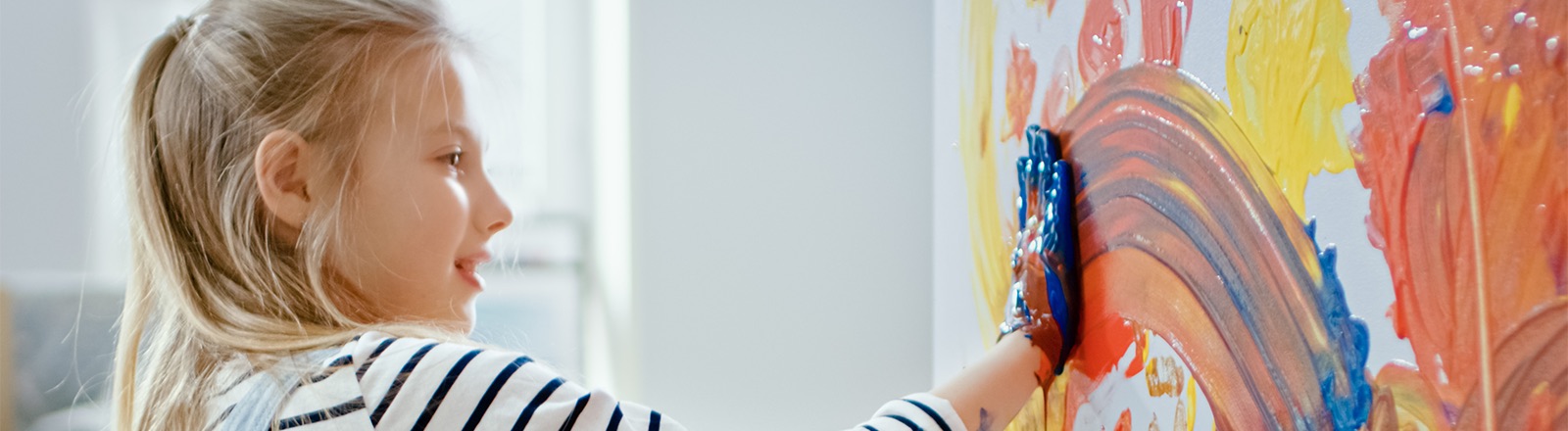
For the youngest, the holiday period is a pivotal moment. The camps dedicated to "Mini Artists" (4-7 years old) should not be envisioned as simple childcare solutions, but as spaces for sensory discovery. At this age, artistic education plays a fundamental role in the development of fine motor skills and self-confidence. Through creative games, manipulation of textures, and discovery of colors, the child learns to structure their thinking and express their emotions without necessarily going through speech.
The pedagogical approach here privileges the process over the result. In a well-designed workshop, each little participant advances at their own pace, supervised by professionals who understand the importance of alternating between moments of concentration and downtime. It is a gentle introduction to the world of arts, preparing the foundations for future school learning. The objective is to nourish their natural curiosity while offering them a secure framework, far from the sometimes intimidating agitation of large collective structures.
Autonomy for 8-16 Year Olds: Creating to Build Oneself
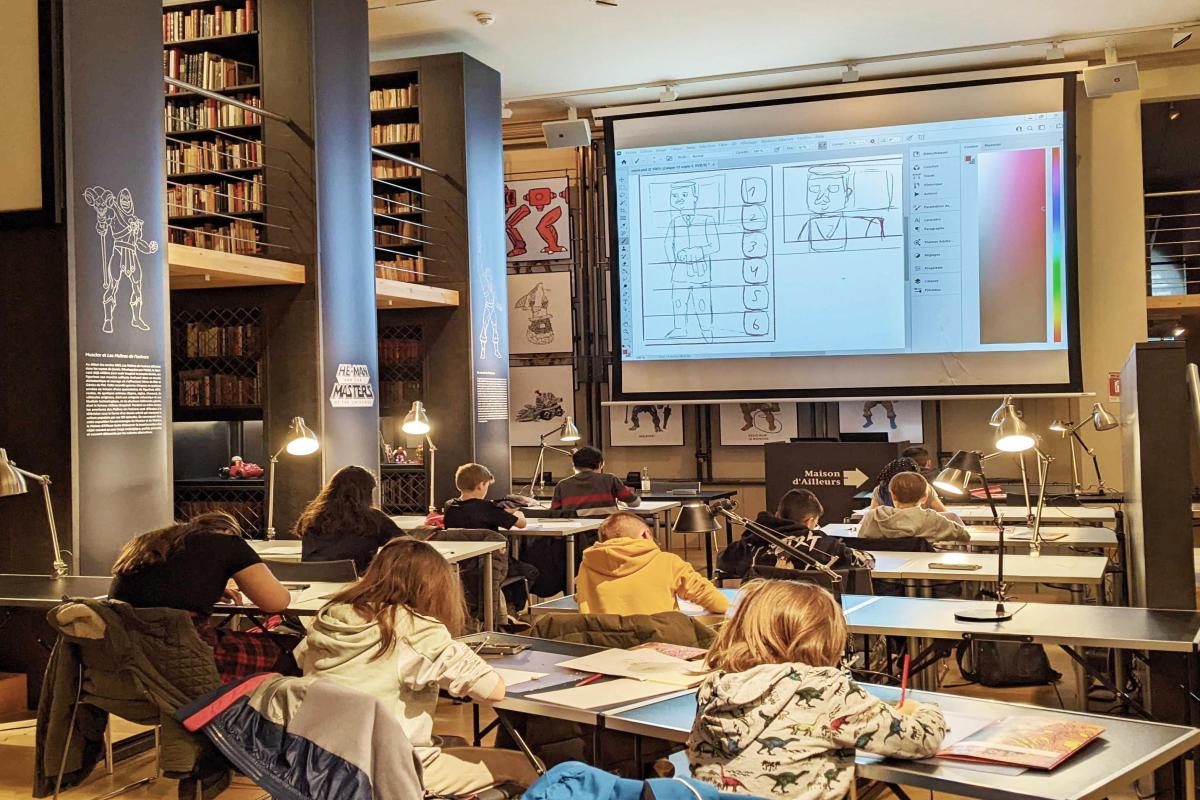
For youth and adolescents, the stakes are different. At an age where identity construction is central, artistic camps (Manga, Theater, Visual Arts) offer a powerful outlet. Unlike school where evaluation is permanent, the artistic camp is a space of freedom. Creating a comic book page or embodying a character on stage allows the adolescent to channel their energy and explore facets of their personality in complete safety.
These intensive courses over a week also promote positive socialization. United by a common passion, the youth weave strong bonds, stepping out of the isolation that screens can sometimes engender. The role of the teacher here is that of a mentor who guides towards being autonomous. By leading a creative project from A to Z during their camp, they acquire a sense of responsibility and a pride of accomplishment (self-esteem) that will reflect positively on their attitude in class and at home.
Art as a Necessary Counterbalance to Sport and Performance
In a region like Switzerland, and particularly in Geneva, the culture of sport is omnipresent. It is frequent and completely healthy to enroll one's children in weeks of skiing, climbing, or football. However, the child's development requires balance. Chaining physical performances can lead to fatigue, both muscular and nervous. This is where artistic activities make total sense as an essential complement.
Proposing a week of "creative detox" after a camp focused on adventure or nature allows the child to re-center. Where sports solicit adrenaline and competitiveness, art invites introspection and inner calm. This alternation is beneficial for the mental health of young people. It teaches them that there are different ways to fulfill oneself: one can surpass oneself on a climbing wall, but one can also travel very far while sitting in front of a drawing sheet.
Moreover, for children less attracted by the competitive aspect of certain sporting hobbies, art offers a validating refuge. In a drawing or theater class, there are no winners or losers, only singular expressions. This inclusive approach is essential for children who do not find themselves in classic multi-sport activities. By varying experiences, you offer your family a complete educational richness, touching the body, the heart, and the mind.
Practical Information: Organizing Your Week Without Stress
The logistical aspect remains the sinews of war for registrations. Understanding the practical functioning of these structures is essential to anticipate and serenely organize your professional and family agenda.
A Format Adapted to Active Life
The majority of artistic camps in Geneva are designed as day care. It is important to note that this is not a residential holiday colony with accommodation on site. Children return to their beds every evening, which is often preferable for the youngest or to maintain family life in the evening. However, to alleviate constraints for parents who work, supervision during the noon break is a crucial option. It allows for a continuous day, where children share a convivial moment (often with their own picnic) under surveillance, thus avoiding a tedious round trip in the middle of the day.
Location and Accessibility
The choice of location is strategic. The best centers are often located near transport axes or large school campuses. Whether you come from the city center or the periphery, accessibility is key. Furthermore, the dates of the camps are generally aligned with the calendars of Geneva public establishments, but also with those of private and international schools like the IIL (Institut International de Lancy), in order to cover all break periods.
Safety and Supervision
Entrusting what is most dear to us requires absolute confidence. Serious structures make safety a point of honor. This involves small group sizes, supervision by professional adults and not simple students, and adequate insurance coverage for the professional activity (although the child's personal accident insurance remains required). Unlike distant stays, proximity allows for immediate reactivity in case of need, a reassuring detail for anxious moms and dads.
Transparency of Costs
The holiday budget is a significant item. Tariffs, expressed in CHF, must be readable and without surprises. A quality camp represents an investment in your child's human capital. When you compare prices in CHF, take into account the instructor/student ratio, the quality of materials provided (often included in visual arts courses), and the actual duration of care. Schools like Apolline Ecole d'Arts offer, for example, a clear pricing schedule adapted to local families.
Why Book Your Places Now?
Anticipation is the keyword. In Geneva, the demand for quality activities during school holidays often exceeds supply, especially for structures offering this famous "multi-age" flexibility. Waiting until the last minute for registrations is a source of stress that you can avoid.
By planning today the weeks of February or Easter 2026, you offer yourself priceless peace of mind. You also allow your child to project positively: "In two months, I'm going to do my Manga camp!" This joyful anticipation is an integral part of the pleasure of holidays. It is also an opportunity to discuss with them, validate their desires, and show them that their interests are taken seriously.
Furthermore, offering creative hobbies is a lasting gift. The skills acquired—patience, observation, expression—will remain anchored well after the end of the week. It is an educational investment that marvelously complements purely academic learning at school. In an urban world like our beautiful city, these bubbles of creativity are essential breaths.
Conclusion: Towards Found Family Harmony
Ultimately, harmonizing the schedules of all siblings is not a utopia. It is a question of strategic choice. Opting for artistic camps in Geneva capable of welcoming young and old in the same place is the most elegant answer to the logistical puzzle of parents.
This allows you to reconcile your professional obligations with the well-being of your children. You transform commute times into moments of exchange, you avoid dispersion, and above all, you offer each youth in the family an enriching experience adapted to their age. Whether it involves discovering painting, getting initiated into theater, or perfecting their pencil stroke, these moments are precious. So, for these upcoming holidays, choose serenity. Simplify your life, while considerably enriching theirs.