
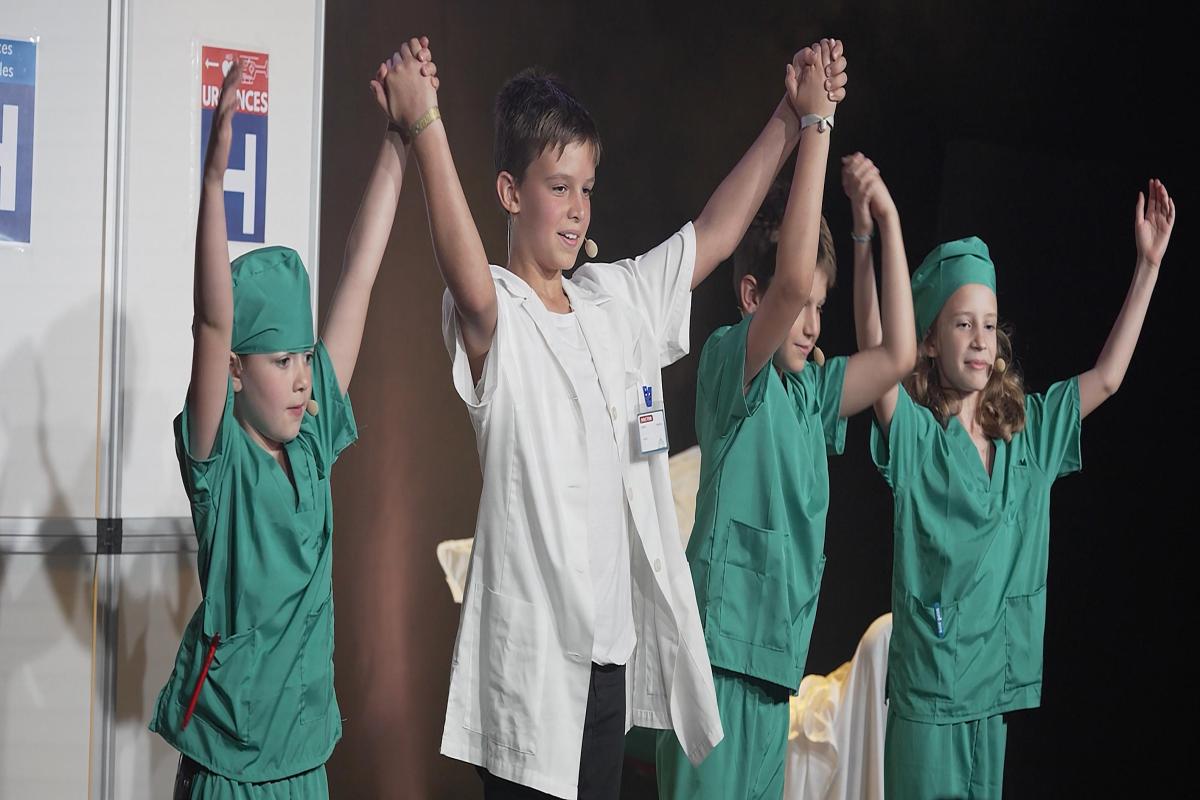
The Back-to-School Dilemma: Choosing Between the Stadium and the Stage for Your Children
Every year, when the horizon of the back-to-school season or the start of a new calendar year approaches, parents find themselves facing an important decision regarding the balance of their family. Should one prioritize sports, often perceived as the ideal outlet for the overflowing energy of the youngest, or turn towards an artistic activity? In this month of December 2025, we are observing a fascinating trend: theater classes are increasingly establishing themselves as a privileged choice for personal development.
Why this paradigm shift? Because modern education no longer seeks only physical performance, but aims for the global fulfillment of the child. Choosing training in dramatic arts means offering your offspring much more than a hobby; it is giving them keys to understand the world and express themselves within it. Whether through a regular workshop in Lausanne or during an intensive course during the holidays in Geneva, the experience of the stage cultivates a unique inner richness. Unlike sports where one learns to defeat an opponent, theater teaches us how to conquer ourselves.
Self-Confidence: An Inner Journey Beyond the Show
Confidence is often the first benefit mentioned, but its profound nature sometimes remains misunderstood within the framework of theater classes. It is not solely about daring to face the gaze of the audience during the final show. The real work is a daily journey, invisible and precious. For a reserved child, daring to take their place on stage is a victory over their own doubts, an act of courage much more intimate than scoring a goal.
Guided by a benevolent teacher, the student learns to tame their image and their body. This progressive awareness is fundamental for their self-esteem. Through playful exercises on voice and posture, the group becomes a secure cocoon where everyone can bloom. Adults who had the chance to follow this training during their youth often testify to a natural ease in their social interactions.
This unique experience transforms anxiety into creative strength. Where sports competition can sometimes generate stress linked to the result, theatrical work values every step of individual progress. Whether a beginner or advanced, every child advances at their own pace. The confidence gained during a successful improv or the sensitive interpretation of a text constitutes invaluable emotional baggage for the future adults they will become. In the canton of Vaud and everywhere in Switzerland, this pedagogy of encouragement is at the heart of the workshops offered.
Group Spirit and Improv: Learning Collaboration, Not Competition
If team sports forge team spirit in the face of opposition, theater teaches a more subtle form of collaboration: absolute solidarity. In an improv workshop, listening to the other is the sine qua non condition for success. If a child seeks to shine alone, the magic of the stage dissipates. This interdependence creates a social dynamic where empathy replaces rivalry.
Improv requires children and teens to unconditionally accept the proposals of their acting partners. It is a magnificent school of humility and adaptation. For adolescents in the midst of identity construction, often centered on their own turmoil, it is a revelation: they exist through the benevolent gaze of the group. This human training is essential for weaving authentic ties. Many parents observe with joy that their children become more open and attentive to others after a few months of classes.
A theater troupe functions like a second family. From the lead role to the smallest extra, every person is indispensable to the harmony of the show. This sense of belonging is vital for young people who can sometimes feel isolated in the school environment. In Lausanne as in Geneva, art schools insist on this warm cohesion. The collective work led throughout the year weaves deep friendships, based on the sharing of strong emotions rather than on competition.
Training for School and for Life
There exists an obvious synergy between theatrical practice and success in the school environment. Learning texts, dissecting the structure of a story, and understanding the complex psychology of characters are stimulating intellectual exercises. This gymnastics of the mind naturally strengthens the memory and concentration capacities of your child, precious assets for their academic path.
But artistic education goes further: it gives meaning to learning. A student following dramatic training approaches presentations at school with a new serenity. The mastery of their voice, their breath, and their articulation are concrete technical tools that they will be able to use all their life. For teens preparing for oral exams, this ease is a decisive advantage. They learn to structure their thought and to captivate an audience, whether it involves a large public or an exam jury.
Furthermore, theater opens a vibrant window onto culture. By exploring classic or modern texts, young people discover literature not as a constraint, but as a living subject. The classes provided in cities like Lausanne integrate this cultural dimension, transforming the school obligation into passion. The adults who supervise them transmit this love for language and expression, offering students a powerful means to appropriate their own culture.
Emotions, Creativity, and Art: The Pedagogical Advantage of Theater
In our digital world, reconnecting the youngest to their real emotions is a priority educational mission for many parents. Theater offers a sanctuary to explore the whole range of human feelings without judgment. Playing anger, intense joy, or sadness allows the child to name and better manage their own feelings on a daily basis. It is a form of emotional education that sports rarely approach with as much finesse.
Creativity is solicited at every moment. Whether to invent a story in improv or to find an original gait for a role, the imagination is bubbling. This awakening is crucial for the cognitive development of children. Unlike cinema where acting can be fragmented, theater is an art of the present moment. This authenticity helps young people to lift their eyes from screens to reconnect with the human.
Dramatic art also allows the exploration of facets of one's personality that daily life does not always allow one to express. A shy child can become a powerful king, an agitated adolescent can embody wisdom. This flexibility is a major asset for their construction. Workshops are laboratories of life where one has the right to try, to make mistakes, and to start over.
Practical Aspects: Budget in CHF and Organization in French-speaking Switzerland
When it comes to choosing an activity, the question of the budget in CHF is naturally a concern for families. It is reassuring to note that a year of theater classes often represents a reasonable investment, comparable to sports fees. In Switzerland, the rates remain accessible for an activity supervised by passionate professionals.
In Lausanne, Geneva, or elsewhere in the canton, the offer is rich. The prices announced in CHF generally include the entire pedagogical service. Unlike certain disciplines requiring expensive equipment, theater demands little material: a comfortable outfit often suffices. It is a democratic means to access a quality cultural practice. Many schools moreover propose rates adapted for siblings, making this art accessible to a large public.
Flexibility is also an asset for family organization. If the commitment over a full year scares you, the school holidays offer ideal opportunities to test. Intensive courses during the holidays allow a playful immersion over a week. It is a perfect formula for a beginner wishing to discover the activity. These punctual workshops, available from Lausanne to Yverdon, often conclude with a small presentation, immediately valuing the work accomplished by the students.
Acting and Dreaming: From Play to Cinema
Many adolescents nourish dreams of cinema and acting. It is important to explain with pedagogy to young people that theater is the indispensable foundation of any serious actor. The technique of acting, the understanding of stakes, and the management of emotions are acquired first on the boards.
Theater classes are the entry door towards this fascinating universe. They allow one to understand that talent is the fruit of rigorous work. For those who dream of cinema, beginning with a workshop in Lausanne or Geneva is the first necessary step. This allows testing their real motivation and their capacity to invest themselves in demanding training.
Interpretation facing the camera requires a subtlety that relies on the bodily expression learned on stage. By understanding this, teens remain motivated, linking their weekly practice to their modern aspirations. Certain structures like Apolline Ecole d'Arts integrate this global vision into their pedagogy in Lausanne, Yverdon, and Etoy.
Conclusion: An Investment for Your Child's Future
Ultimately, the choice between sports and theater must not be an agonizing dilemma. Both bring complementary benefits. However, to develop verbal ease, confidence in oneself, and the intelligence of the heart, theater is an irreplaceable tool. Whether for a year of discovery or for a passionate curriculum, enrolling your child or your teen in a dramatic art course is offering them peaceful weapons to confront the world of adults.
The investment in CHF is modest regarding the human skills acquired: listening, empathy, and creativity. In a world in perpetual mutation, these qualities are the true keys to fulfillment. For the next start of the school year or the next holidays, dare to push the door of a workshop and let the magic of the stage operate in the life of your child.