
From Stage to Screen: Understanding the Fundamentals of Acting
In 2026, the allure of screens is undeniable and many young people harbor the secret dream of shining in cinema or on streaming platforms. However, for parents who wish to support this desire, it is essential to understand a fundamental pedagogical reality: theatre remains the best school to train an actor, whatever the final medium. A well-structured drama class does not content itself with teaching texts; it offers complete training on the actor's most precious tool: their own sensitivity.
The technical difference between acting for camera and working on stage is often misunderstood. While cinema allows for retaking a take infinitely, the stage demands an immediate and constant truth. In our school, we often explain that this requirement for live performance forges an iron discipline. The work of character interpretation demands a deep analysis of emotions, a skill that then allows the actor to adapt to the minimalist nuances required by the camera. It is this rigor acquired on the boards that makes the difference during an audition, whether one is a beginner or a confirmed professional.
Improvisation also plays a key role in this learning process. This discipline, a pillar of our workshops, teaches active listening and reactivity. Contrary to popular belief, improv is not reserved for experts; it is accessible to children as well as adults. Knowing how to bounce back from the unforeseen is an invaluable quality for acting, as it allows one to remain organic and alive, even after the tenth take of the same sequence. For adolescents used to controlling their digital image, improvisation offers a space of raw and authentic freedom.
It is touching to see how our students, whether children or older, discover that the techniques learned for the stage give them a head start. Space management, awareness of light, and the relationship with the partner are solid acquisitions. Thus, a year of regular theatrical practice is often worth much more than numerous theoretical camera workshops, because it anchors reflexes in the body.
Voice, Body, and Confidence: The Actor's Indispensable Tools
The body and the voice are the actor's instruments, and like any instrument, they must be tuned. In a theatre class, the emphasis is placed on disinhibition and body mastery. For many teens, this step is a true metamorphosis. Theatre allows them to fully inhabit their body, transforming the clumsiness sometimes linked to age into a force of scenic expression. It is a powerful emotional process that durably builds self-confidence.
Vocal projection is another pillar of our teaching. Learning to project one's voice so that it reaches the last row of the audience without forcing demands precise technical work. This skill is crucial: an actor who knows how to project on stage will know how to modulate their intensity for a cinema microphone. For shy children or young people who do not dare to speak up, this discovery of their vocal power is often a revelation that goes beyond the purely artistic framework.
The confidence that one gains by facing the gaze of the audience is unique. Unlike other extracurricular activities, drama exposes the individual's vulnerability. In the benevolent environment of our school, this vulnerability becomes a strength. Stepping onto the stage means accepting being seen as one is. For a child or an adolescent, succeeding in overcoming this stage fright is an immense victory over oneself, reinforcing self-esteem much more effectively than any theoretical speech.
This ease acquired through theatrical practice is what casting directors are looking for: a "presence". Whether it involves adults in retraining or a passionate child, the path is the same. The work in the workshop allows for exploring the entire palette of human feelings in a secure framework, offering students the keys to manage their stress and channel their creative energy.
Group Dynamics: Learning Within a Troupe
The actor only exists through the gaze of the other. That is why group dynamics are at the heart of our pedagogy. In our theatre classes, we insist on the fact that acting is an exchange. Children learn very quickly that to be good, one must make one's partner shine. This solidarity creates deep bonds, often transforming the class into a second family. For teens sometimes isolated in the school environment, finding their "troupe" every week is an indispensable breath of fresh air.
The role of the teacher is decisive here: they are the conductor who harmonizes personalities. They guide the group so that each child finds their place, while respecting everyone's individuality. This education in empathy and listening is a major added value. Knowing how to listen to the other, accepting their proposals in an improvisation exercise, is learning respect and collaboration, essential qualities for the future adults they will become.
Work on texts is also a moment of intellectual and emotional sharing. Dissecting a scene together, understanding the characters' motivations, stimulates collective creativity. Young people learn to build together, to debate, and to create a common vision. It is a rich human experience that prepares them for life in society, well beyond purely artistic skills.
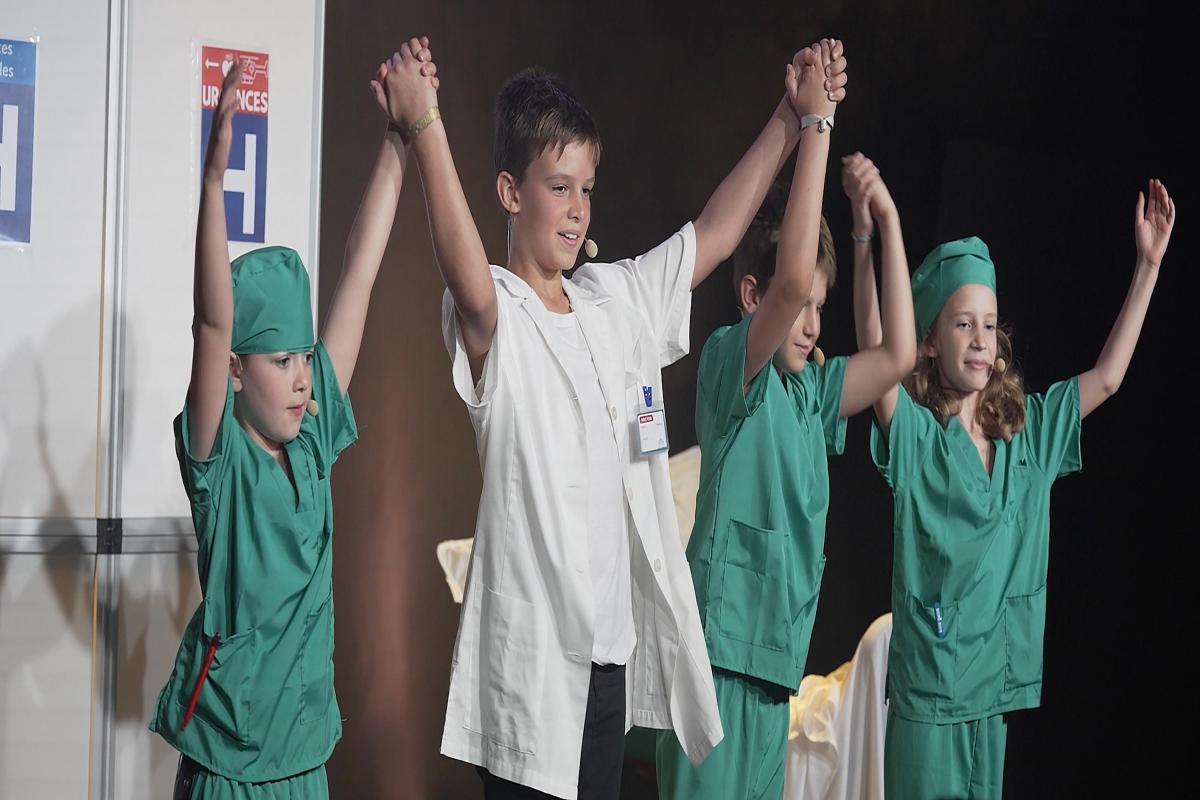
The culmination of this collective adventure is often the end-of-year show. This moment of communion with the audience is the peak of the work accomplished. The adrenaline shared backstage, the mutual help for costumes, the mutual support in the face of stage fright: these moments weld the group together forever. It is a collective emotion that cinema, with its fragmented shoots, sometimes struggles to reproduce with the same intensity.
What Age to Start? Children, Teens, and Beginners
Parents often ask us what is the ideal age to enroll their child. In reality, there is no perfect moment, but adapted approaches. For smaller children, our classes are focused on awakening and playful games. For teens and adolescents, the training becomes more technical, approaching text analysis and psychological construction. Even adults can start and discover unsuspected facets of their personality.
It is never too late for a beginner. A 16-year-old adolescent who has never done theatre can progress dazzlingly if guided with benevolence. Likewise, we see adults joining our workshops to gain professional assurance. The important thing is to commit over time: a complete year allows for real and visible evolution, whereas a simple discovery workshop would only scratch the surface.
The evolution of a child within the school is often spectacular. The one who arrived shy in September often ends up claiming the front of the stage in June. This progression respects everyone's rhythm. Our workshops are designed to accompany this emotional maturation. For the youngest, it is an exploration; for adolescents, it is a crucial identity affirmation in a period of life often tormented.
In Switzerland, and specifically in our canton, we are lucky to have privileged access to culture. Choosing a structure that offers true pedagogy, with a qualified teacher, is essential. Whether the goal is a career in acting or simply personal fulfillment, the regularity of weekly work is the key. It is a commitment that bears fruit well beyond the current year.
Why Choose a Course in French-speaking Switzerland (Lausanne, Geneva)?
The Lake Geneva region, encompassing Lausanne and extending to Geneva, offers an exceptional cultural breeding ground. Enrolling one's child in a local school allows them to anchor themselves in this dynamic artistic fabric. Our weekly classes located in Lausanne, Yverdon, and Etoy attract students from the entire canton. Even if our weekly classes are not in the center of Geneva, many families do not hesitate to join us, notably for our Holiday Camps which radiate throughout French-speaking Switzerland.
Let's speak concretely about investment. The cost in CHF is a legitimate consideration for every family. However, one must view this rate (from 79.- CHF per month for a course) as a long-term investment in the child's development. Compared to other activities, the price-quality ratio of artistic training that develops so many human skills is excellent. This amount in CHF covers not only the trainer's expertise but also access to an equipped room and a professional structure.
The rhythm of the year is also punctuated by holiday periods. This is the ideal time for intensive workshops. These weeks allow young people coming from Fribourg, Neuchâtel, Sion, or Geneva to experience total immersion. Creating a show in five days is a stimulating challenge that accelerates learning. The price of these workshops (from 290.- CHF) includes an unforgettable human adventure, often the source of lasting friendships across the canton.
Switzerland offers a secure framework for these discoveries. Our infrastructures in Lausanne and elsewhere allow working in optimal conditions. No need to go into exile to find excellent training; the expertise is here, close to home. The mix of our students, local or international, enriches the creativity and open-mindedness of the group, preparing children to evolve in a cosmopolitan world.
As parents, you are looking for the best way to support your children. Theatre is a powerful tool to help them grow. Whether they become tomorrow's cinema stars or adults fulfilled in a completely different field, the skills of confidence, listening, and presence acquired on stage will remain engraved in them. It is a total life experience.
Finally, for creative minds wishing to explore other narrative horizons, there are interesting bridges. Some of our students complete their scenic training with a Manga course, thus refining their sense of visual storytelling. It is this multidisciplinary curiosity that we encourage within our structure.