
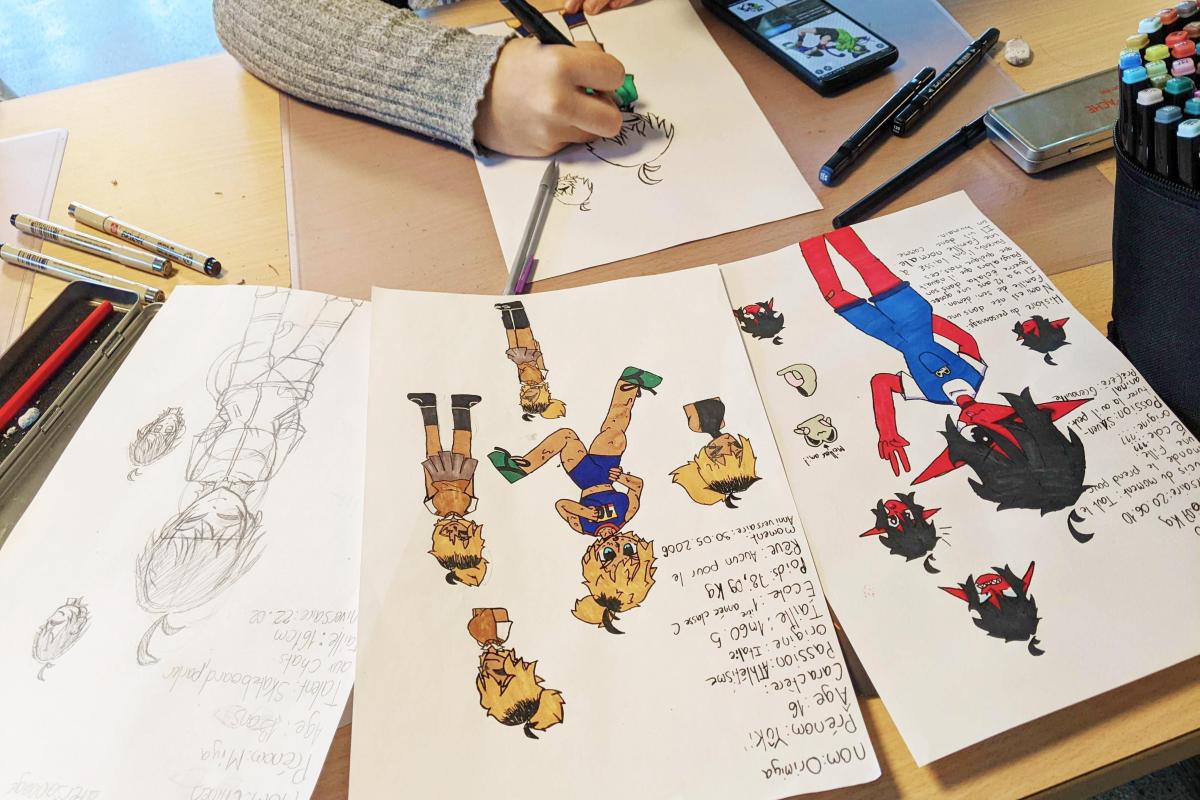
From Manga Passion to Academic Requirements: The Challenge of Great Schools
Admission to prestigious institutions like HEAD in Geneva or ECAL in Lausanne represents the ultimate dream for many young artists. In this early year 2026, competition is tougher than ever, and juries are looking for distinct artistic personalities. While manga is often the gateway to the world of art for the new generation, it sometimes suffers from a stubborn prejudice in the school and academic environment. However, technical mastery of the Japanese style, when enriched and diversified, can become a major asset in a file for an art school.
To succeed in your admission, do not just present classic manga pages. Integrate varied techniques and rigorous observation studies. Show your creative process and your curiosity by blending manga codes with a contemporary and personal artistic approach. It is the best way to prove your versatility in the eyes of experts.
The key lies not in abandoning your passion, but in its evolution. It is about proving that your manga courses have taught you rigor, a sense of storytelling, and composition, while demonstrating your ability to step out of your comfort zone. Hard work on the diversity of approaches is essential to transform a child's or teenager's hobby into a mature and professional artistic practice. It is a strong emotional journey, where the student learns to defend their graphic identity.
Diversifying Techniques: Beyond Traditional Inking
One of the first steps to solidify a portfolio is to broaden your palette of techniques. If your manga courses focused on pen, ink, and screen tones, it is time to explore other horizons. Art schools look to see how you manipulate matter and color, beyond the simple line.
The Importance of Materials and Experimentation
The choice of material says a lot about your curiosity. Do not hesitate to integrate watercolor into your illustration creations. This technique, very popular in children's publishing and concept art, brings a vibration and transparency that alcohol markers do not always allow. Similarly, acrylic offers a texture and opacity that can give body to your compositions. Working with oil requires patience and management of drying times that prove your discipline to the jury. It is an excellent exercise for any child or teenager wishing to professionalize.
In our workshop, we encourage students to mix mediums. Imagine a manga character whose contours are made with charcoal for a raw and expressive effect, or colored with watercolor for a dreamlike atmosphere. This hybridization is the mark of a rich artistic profile. The work of the material shows that you are not content to reproduce codes, but that you are looking for your own language. The intelligent use of material then becomes a storytelling tool in its own right.
Mastering Black and White and Color
Manga is traditionally an art of black and white. It is a strength for managing values and contrasts. However, a complete file for a higher school must explode with color. The use of acrylic or oil allows working on color theory, complementaries, and temperatures, essential notions evaluated during exams. A good Manga course should not lock you in, but give you the bases of drawing to then explore all facets of visual art.
Anatomy and Observation: From Style to Reality
The main trap for manga enthusiasts is early stylization. Big eyes and distorted proportions are aesthetic choices, but to master them, one must first understand reality. Juries at HEAD or ECAL will systematically check your skills in observational drawing. It is a crucial step in learning.
Studying the Living in All Its Forms
To enrich your work, get out of the workshop. Sketch the world around you. Draw a baby to understand the specific proportions of early childhood, very different from those of an adult. Observe a couple sitting on a bench to grasp interactions, the weight of bodies, and the folds of clothes. Drawing a whole family allows working on relative scales of size and the diversity of morphologies. These subjects, like the baby or the couple, bring a touch of real life often absent from purely "imaginary" portfolios.
These sketching exercises from life are complementary to your usual courses. They refine your eye and your understanding of muscular and bone structure. A student who knows how to draw a realistic hand with charcoal will have much more credibility when they decide to stylize it in a manga page. The line must be lively, varied, and convey an understanding of volume. It is this link between the real and the imaginary that touches the viewer and the jury.
Different Levels of Graphic Reading
Your portfolio must show different levels of finish. Quick sketches, advanced anatomical studies, and a finished illustration. This variety proves that your creativity is not frozen. Learning to draw is a long process, and showing your research sketchbooks is often as important as showing final works. This is where the accompaniment of an experienced teacher becomes crucial to select the best pieces produced during the year.
The Importance of Teaching and Follow-up
Preparing a file for a high art school cannot be improvised alone in one's room. The teaching received plays a determining role. A good teacher is not content to correct your mistakes; they guide you towards autonomous artistic reflection. They help you transform a leisure practice into a professional approach.
Personalized Supervision to Progress
In the context of a course, the exchange with the teacher allows taking a step back on one's production. They will help you identify your graphic tics (often inherited from manga) to transform them into conscious style. Artistic education is also learning to talk about one's work, to justify choices of material and composition. These oral skills are tested during admission interviews. This is why our manga courses integrate this critical and analytical dimension.
It is often beneficial to follow general Visual Arts courses in parallel with your specific practice. This allows confronting other visions, d other historical and contemporary references. The goal is to build a solid artistic culture that will nourish your manga creations. This openness is essential to succeed in your exams.
Moreover, the diversity of practices is valued. Having rhythmic notions thanks to Music courses or developed bodily ease through Theater courses can enrich your approach to drawing, especially in the dynamism of poses and staging. Everything is linked in artistic education.
Holidays and Internships: The Final Sprint
The school year is often busy, and it is difficult to free up time for large-scale projects. Holiday periods are therefore strategic for the constitution of your file. It is the ideal moment to participate in intensive workshops.
The Advantage of Art Camps
Participating in workshops during breaks allows totally immersing oneself in creation. Without the pressure of homework, the mind is free to explore. Our Holiday camps offer this privileged space-time. During a week, children and teens can produce a phenomenal amount of work, often superior to what they achieve in a term of weekly courses. It is a pivotal period to evolve one's style.
It is during these workshops that one can launch into larger formats, test oil painting which requires time, or realize a complete short manga story. Group emulation, the act of drawing with other enthusiasts, creates a dynamic of rapid progression. These collective activities are also the opportunity to receive precious advice from other students and instructors.
Exploring New Cities and Inspirations
Whether in Geneva, Lausanne, or elsewhere in French-speaking Switzerland, changing surroundings stimulates creativity. Urban outings to sketch architecture or urban landscapes enrich your mental image bank. A credible manga setting often relies on real documentation. Take advantage of holidays to fill your sketchbooks: train stations, parks, museums. These observation drawings, even imperfect, are gold for your file because they testify to your daily curiosity and your will to learn.
Art for Everyone? From Student to Pro
Artistic practice has no age, and it is never too early or too late to start building one's graphic identity. It is an adventure that concerns the whole family.
For children, the approach is playful. The goal is to preserve spontaneity while gently introducing notions of techniques. A child who starts manga courses early acquires precious motor ease. For an older beginner or a student of medium level, the stake is often to deconstruct fears to find the pleasure of the line. This is where the benevolence of the workshop plays its full role.
Adolescents aiming for art schools are in a pivotal phase. They must move from a practice of consumption to a practice of creation. It is often at this stage that the click happens, transforming a school hobby into a vocation. But let's not forget the adult! Many adults return to drawing or embark on learning manga for pleasure. Intergenerational workshops are very rich: the freshness of the youngest inspires the elders, while the patience of adults channels the energy of children. This mix in our courses creates an environment conducive to the fulfillment of everyone.
Exam Preparation: The Home Stretch
The year preceding the competitions is decisive. It is the moment of curation. It is no longer about showing everything, but choosing. Your portfolio must tell a story: yours. It must reflect your skills acquired over time.
Structuring Your File
A good file for a school like HEAD or ECAL must be balanced. You must know how to dose traditional and digital arts.
- 30% academic technique: Observation drawing, live model (nude or clothed), still life. Show that you master perspective, anatomy, and light. Use charcoal, pencil, watercolor.
- 40% personal projects: This is where your manga has its place. Present original pages, character designs, storyboards. Show your universes. It is your heart of creativity.
- 30% experimentation: Sketchbooks, texture research, photos, collages, digital illustration.
Do not neglect presentation. The cleanliness of the work, the quality of scans or photos, the layout: everything counts. It is an exercise in visual communication that requires quality material and a critical eye.
The Advice for the Big Day
During exams and the interview, be ready to defend your love of manga without being defensive. Explain how Japanese narrative codes influence your vision of art, but also show that you are open to other forms of expression. Cite classic artists who inspire you. Talk about your learning, your difficulties, and how you overcame them thanks to your courses and your personal work at home.
Juries like students who have a strong universe but remain "teachable". Show that you have solid bases (acquired during your manga courses and various workshops) but that you are thirsty to learn what the school has to offer you. It is this positive school attitude combined with a devouring passion that will make the difference.
Conclusion: Your Artistic Future
Building a solid portfolio to enter HEAD or ECAL with a manga background is an exciting challenge. It requires humility to accept returning to the basics of observational drawing, curiosity to test new techniques like oil or acrylic, and a lot of work. Holidays and workshops are precious opportunities to accelerate this process and refine your technique.
Do not forget that art school is not looking for finished products, but potentials. Your passion for manga, if channeled and open to the global artistic world, is a formidable energy. Continue to learn, to draw every day, and make your dream a tangible reality. For those who are looking for personalized support in this demanding process, our school is here to help you reveal your full potential through our courses and our dedicated activities.