
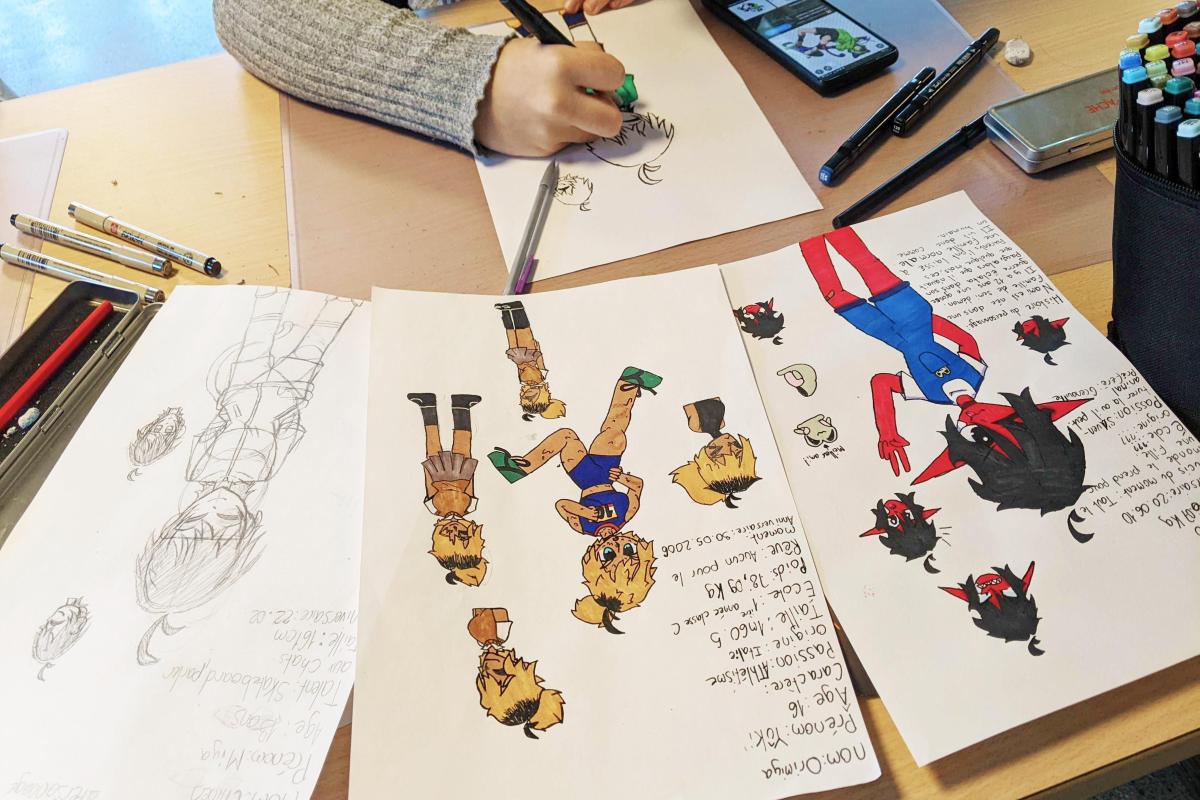
The Art of Character Design: From Imagination to Paper
In this year 2026, the world of manga has definitely transcended its status as simple entertainment to establish itself as a major form of art, respected and studied with passion. For children who dream in front of their favorite pages as well as for the adult who wishes to finally materialize their ideas, character creation – or "Character Design" – is often the gateway into this fascinating universe. But how to move from a blurry mental image to a vibrant illustration full of life on paper? It is an emotional and technical journey, an adventure where one must learn to observe the world to better reinvent it.
Creating a character is not just assembling features; it is breathing a soul into a sketch. It is a work of empathy and rigor that requires patience. In a creative workshop or a specialized school, one quickly discovers that artistic freedom is born from the mastery of fundamental rules. Contrary to what is sometimes thought in the classic academic framework, drawing is not a magic gift reserved for a chosen few, but a discipline that is cultivated throughout the year.
This guide aims to accompany you, step by step, in this artistic exploration. We are going to talk about techniques, choice of material, but also about that unique feeling that runs down the spine when the character finally comes to life before your eyes. Whether you are looking for a fulfilling activity for your child or you are yourself seeking improvement, remember that every great master was once a beginner.
Technical Fundamentals: Anatomy, Line and Style
The anxiety of the blank page often comes from a lack of reference points. To build a credible manga character, one must first understand how the human body works. It is a magnificent paradox taught in art schools: one must master anatomical reality to then be able to stylize it with elegance.
Construction and Levels of Detail
The first secret lies in the structure. Essential technique consists of not rushing into details, but building simple "skeletons". The use of charcoal for these first sketches might seem surprising in the world of manga, often associated with ink, but it is a liberating medium. Charcoal allows placing volumes and shadows without the pressure of the definitive line, favoring raw and spontaneous creativity.
Observation is your best ally. Let's take the example of proportions: drawing a baby requires a radically different approach from that of an adolescent hero. One must observe the roundness of the limbs, the imposing size of the head relative to the body, the absence of a marked neck. It is by understanding these anatomical specificities that one acquires the skills to vary their designs. The levels of mastery are often measured by this ability to adapt one's stroke to the age and morphology of the character.
The Stroke, the Line and Interaction
Once the structure is set, the work of the line (or "lineart") comes into play. It is here that the style asserts itself. In manga illustration, inking must be alive: a line is never uniform, it thickens in the hollows and thins towards the light. It is a calligraphy of the body.
A fascinating challenge to progress is to draw not an isolated character, but a couple or a group in interaction. How do glances cross? How does the posture of one influence that of the other? Managing this spatial and emotional dynamic is complex. It is often at this stage that the presence of a teacher becomes precious. A benevolent external gaze allows correcting perspective errors that escape the student's eye, transforming potential frustration into a technical victory. The education received allows unlocking these situations and giving depth to the visual narration.
Exploring Color: Beyond Black and White
If manga is traditionally associated with black and white printing, the universe of color illustration is where emotion literally explodes. In 2026, the trend is a return to matter, to the grain of paper, to stand out from art generated by artificial intelligence.
The Poetry of Watercolor
Watercolor is undoubtedly the queen of techniques for coloring characters. It brings softness, transparency, and light that give a dreamlike dimension to drawings. It is a demanding technique, certainly, but incredibly rewarding. Learning to measure water and pigments requires work and sensitivity. For children, it is a school of patience: one cannot rush watercolor, one must wait, let dry, layer. In a workshop, seeing a color fuse and create an unforeseen gradient is often a moment of artistic wonder. It allows creating atmospheric moods ideal for chapter covers or promotional illustrations.
Acrylic and Oil: Texture and Matter
For those who wish to give more body to their creations, acrylic is a fantastic medium. Opaque, vivid, and drying quickly, it allows working in successive layers, correcting, repainting. It is ideal for a beginner who is afraid of "ruining" their drawing, because the mistake is always salvageable.
Rarer in manga but of infinite richness, initiation to oil painting opens the doors to a quasi-classical rendering. Using oil to paint a manga-style character creates a striking contrast between the modernity of the design and the nobility of the traditional technique. These explorations enrich the student's visual vocabulary. Integrating these varied mediums into a curriculum shows that the boundaries between the different arts are porous and that manga has its full place in fine arts.
Essential Material for Working at Home
Learning does not stop at the doors of the classroom. To progress, one must practice, and to practice, one must feel good at home. Arranging a work space at home is an act of commitment towards one's passion. It is saying to oneself: "This is important to me."
Choosing Your Tools Well
No need to spend a fortune to start, but having the right material changes all the drawing comfort. Here are some tips to build your basic kit:
The support: Forget printer paper that drinks the ink. Invest in smooth Bristol paper for inking or grained paper for watercolor. It is respect for your own work.
The pencils: Use blue leads for your preliminary sketches; they erase easily and often disappear when scanned.
Inking: Calibrated felt-tip pens (fineliners) of different thicknesses are perfect for starting.
Color: A small palette of student quality watercolor or a few alcohol markers suffice to explore color all year long.
Creating Your Creative Sanctuary
Whether in a corner of a child's room or on an adult desk, the important thing is light and ergonomics. A good lamp, a comfortable chair, and above all, a space where one can leave a drawing in progress without having to tidy everything up immediately. This makes it easier to get back to it. For young people considering an academic orientation towards image professions, starting early to keep their creations in a portfolio is an excellent habit. This allows visualizing the progress made and gently prepares for the requirements of admission files for major schools.
Guided Learning: The Importance of Classes and Transmission
If self-teaching is laudable, it has its limits. One can quickly go in circles, repeat the same mistakes, and get discouraged. This is where structured education makes total sense. Taking manga classes offers a benevolent and stimulating framework that video tutorials can never equal.
The Mentoring Role of the Teacher
A passionate teacher does not just transmit a technique; they transmit a flame. They know how to identify why a pose seems rigid or why an expression lacks life. In an art school like Apolline, human interaction is at the heart of pedagogy. The teacher guides the student, helps them find their own style rather than simply copying. This relationship of trust is essential to dare to take artistic risks. Art education is a permanent conversation between the student and their mentor.
Group Dynamics and School Context
Drawing alone in one's room can be isolating. Joining collective classes creates positive emulation. Seeing others progress, exchanging tips, sharing doubts... this social dimension is vital for the morale of young artists. For adolescents, this also allows validating their passion in a serious context. Manga is no longer "just a hobby", it is a subject of study, with its exercises, its challenges, and its successes.
Schools often propose curricula adapted to different ages and objectives, whether it be for leisure or to prepare for entrance exams for high art schools. The objective is to develop solid and durable skills, transferable to other fields of visual arts.
Camps and Holidays: Total Immersion in Creativity
The rhythm of the school year is often frantic, leaving little time for long drawing sessions. Holidays are therefore enchanted parentheses, suspended moments where one can finally dive headfirst into one's passion.
The Breakthrough of Intensive Camps
During a camp, the notion of time changes. Drawing four or five hours a day allows entering a state of intense creative "flow". It is often during these weeks of immersion that the greatest technical breakthroughs occur. The holiday camps are designed to offer this privileged space-time. One can start and finish an ambitious project there, like a complete page or a large illustration in acrylic, which provides immense satisfaction.
Opportunities and Encounters in Switzerland
For families residing in Switzerland, the offer is particularly rich. Whether in Geneva, Lausanne, or elsewhere in French-speaking Switzerland, Apolline's workshops welcome young creators. These holiday activities are also meeting places. One meets other enthusiasts there, makes friends who share the same references, the same dreams. It is a stimulating artistic bath. The camps are often themed – monster creation, architecture, color – allowing deepening a precise aspect of drawing. It is the ideal gift for a creative child: time, material, and friends to share their passion.
Manga for Everyone: Children, Family and Adults
It is time to break a tenacious received idea: drawing does not stop at childhood. Manga is a universal, transgenerational language, which addresses the whole family.
A Passion to Share
We see more and more adults crossing the door of our workshops. Some to reconnect with a youthful dream left fallow, others to understand the universe that fascinates their children so much. Learning to draw can become a wonderful activity to share as a family. Imagine a couple taking a weekly moment to create together, or a parent and their child sitting side by side, each working on their page. Art has this unique capacity to build bridges, nourish conversations, and strengthen bonds.
Personal Fulfillment through Drawing
Whatever the age, artistic practice is a powerful vector of well-being. Succeeding in capturing an emotion in a look, mastering the capricious fluidity of watercolor, or finishing a complex illustration provides a pride that boosts self-confidence. For the adult caught in the whirlwind of daily life, it is a bubble of mental breathing. For budding artists, it is a means of self-affirmation. The classes then become much more than a technical lesson; they are a space of freedom, creativity, and rejuvenation.
Conclusion: Your Artistic Adventure Begins Today
The path of Character Design is infinite and exciting. It begins with a hesitant stroke and leads to the creation of entire worlds. Whether you are fascinated by the rigor of anatomy, the softness of watercolor, or the energy of manga, the essential thing is to start. Do not be afraid of mistakes, they are your teacher. Equip yourself with good material, seek tips from benevolent mentors, and practice with joy.
In 2026, digital tools are everywhere, but the value of the human gesture, of ink on paper, remains inestimable. If you feel the call of drawing, know that our school gives weekly artistic courses: Visual Arts (drawing classes, illustration, painting, Comics & Manga) from age 6 in the Swiss cities of Geneva, Etoy, Lausanne, Montreux, Vevey, Sion, Yverdon, Nyon, Neuchatel, and Fribourg. Your style is only waiting for you to hatch.