The Art of Painting and Drawing in Lausanne: An Invitation to Create in 2025
On this December 18, 2025, as the winter mists gently envelop the shores of Lake Geneva, feeling the need for color and inner warmth is completely natural. Artistic practice offers this luminous refuge. Whether you are a confirmed artist looking to refine your gesture or a beginner curious to hold a brush for the first time, Lausanne reveals itself as fertile ground for inspiration. Signing up for a drawing or painting class is not just a technical step; it is an opening towards a new way of seeing the world, a sensory experience that transforms our relationship to reality.
In our society where everything accelerates, taking the time to learn to observe a shadow, a curve, or a shade becomes an act of poetic resistance. An art school does not settle for transmitting know-how; it offers a benevolent space, a studio where one has the right to fumble, explore, and marvel. In Lausanne, the diversity of pedagogical approaches allows everyone, children and adults alike, to find a path towards their artistic fulfillment, guided by passion and expertise.
Exploring Techniques: Matter at the Service of Emotion
Choosing your medium is a bit like choosing your voice to sing. Each material possesses its own vibration and dictates a particular relationship with the support. In painting classes, we often invite students to listen to their feelings regarding the material before settling on a practice. It is by touching and manipulating that one truly understands the techniques.
The joyful spontaneity of acrylics
For those who like to see their ideas take shape quickly, acrylic is often a revelation. This modern technique, very present in our studios, allows for rapid layering. It forgives hesitations: a mistake is corrected in a few brushstrokes once dry. Acrylic invites movement and boldness, which is ideal for liberating creativity without the fear of "ruining" the canvas. It adapts to all temperaments, from the most impulsive to the most meticulous.
Watercolor: taming water and letting go
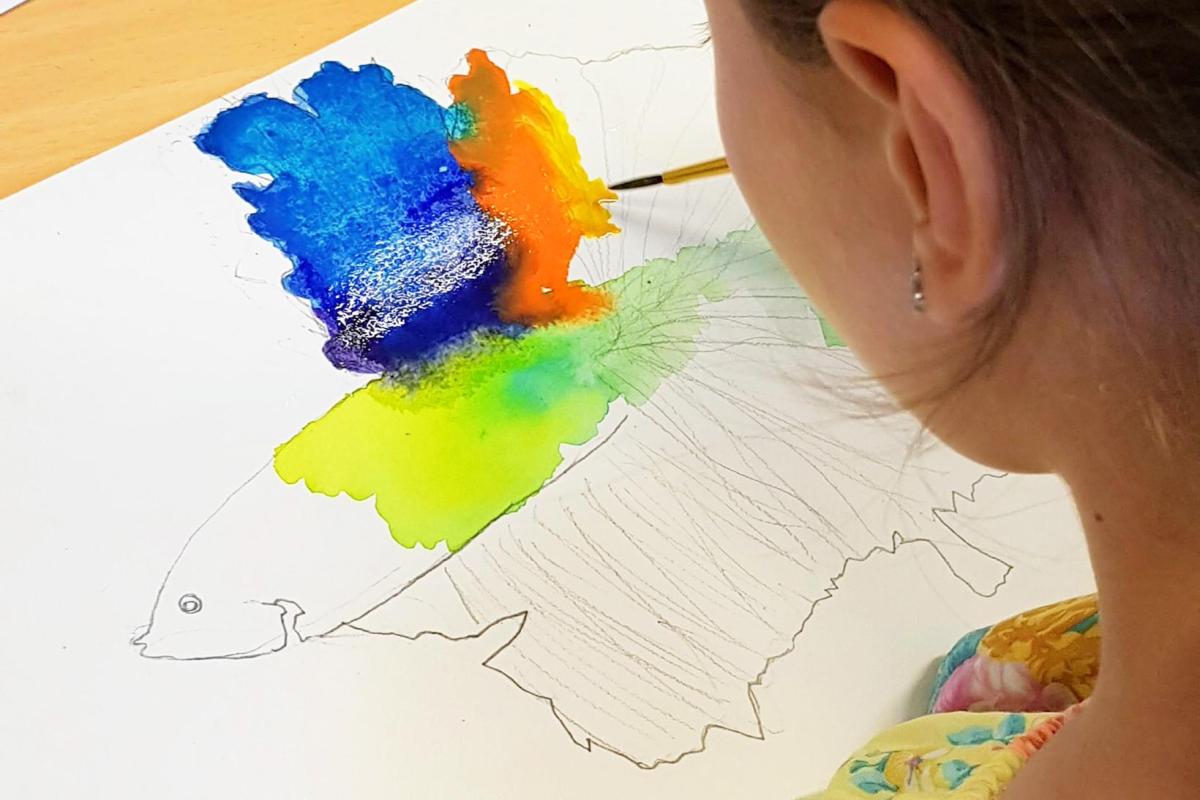
Conversely, watercolor is a school of humility and delicacy. It is the dialogue with water that creates the magic. Learning watercolor means accepting that you do not control everything. It is a meditative practice, perfect for capturing the changing atmospheres of Lausanne or filling a travel journal. It demands patience and great sensitivity, qualities that a teacher will know how to gently awaken in you.
The sensual depth of oil painting
Oil remains the queen of materials for many artists. Its creaminess and slow drying time allow working on blending, light, and depth like no other medium. It is a technique that teaches construction over time, layer after layer. In an arts school, approaching oil is often experienced as a rite of passage, a connection with the great history of painting.
Drawing and Illustration: Learning to See
Before even speaking of color, there is the line. Drawing is the skeleton of any artistic work. It is not just about copying, but understanding the structure of things. A good drawing class will teach you to deconstruct the world into simple shapes to better reconstruct it on paper.
Illustration, whether narrative or poetic, allows for telling stories. For enthusiasts of imaginary worlds, working with charcoal for its deep blacks or pastel for its velvety softness offers infinite possibilities. The work on the line is also the coordination between eye and hand, a gymnastics of the mind acquired through the benevolent repetition of exercises. The quick sketch captures the essence of a moment; it is a wonderful tool for developing one's sense of observation daily.
The Pedagogical Relationship: The Key Role of the Teacher
We sometimes think we can learn everything alone behind a screen, but nothing replaces the gaze of a teacher. Artistic transmission is a human relationship above all. A good teacher does not just correct perspective; they encourage, reassure, and guide the student through their doubts.
Emotional and technical support
In the intimacy of the studio, the teacher perceives blockages that are not always technical, but sometimes linked to self-confidence. Our teachers are trained to transform the frustration of failure into a learning opportunity. The reviews of our participants often testify to this click: the moment when, guided by an expert hand, one finally understands how to render the volume of an apple or the sparkle of a gaze. These sessions become privileged moments of sharing, where the benevolence of the group lifts everyone up.
Progression adapted to everyone
In an art school worthy of the name, there is no single method, but individualized paths. Whether you have a beginner or confirmed level, the teaching adapts to your ability and your pace. Artistic training is a personal path; the role of teachers is to light the road, not to walk it for you.
Children and Adults: Two Worlds, One Passion
Pedagogy must adjust to the age and aspirations of students. If the foundation of visual arts remains the same, the way of approaching it differs greatly between a child and an adult.
The creative wonder of children
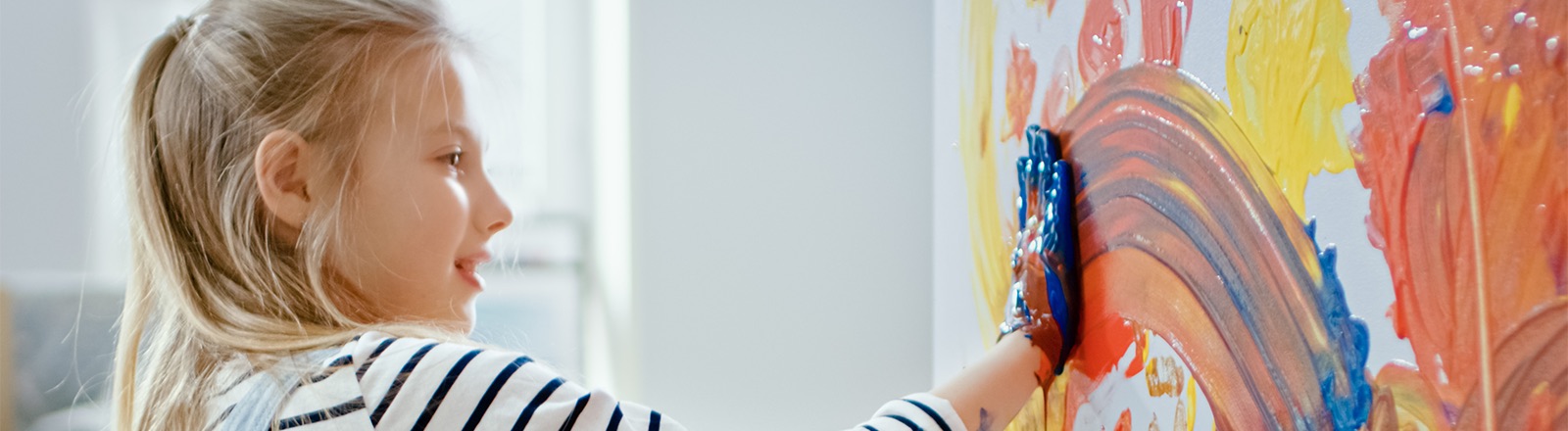
For children, the studio is a space of absolute freedom. The goal is to channel their formidable creative energy without ever extinguishing it. Classes for the youngest in Lausanne are designed as playful explorations. We mix illustration, painting, and collage to tell stories. The child develops their fine motor skills and sense of observation while having fun. It is a space where there are no "mistakes", only inventions. Seeing a child proud of their creation is the most beautiful reward for a teacher.
The well-being break for adults
For adults, crossing the threshold of a painting class is often a step towards reconnecting with oneself. After a stressful work week, the studio offers a parenthesis out of time. Adults often need to deconstruct the idea that they are "not gifted". With a gentle and structured pedagogical approach, they discover that technique is acquired and that personal expression is accessible to all. It is a powerful means to let go and cultivate one's inner life.
Materials: Accomplice of Your Creation
The relationship with materials is intrinsic to the practice of arts. It is not about consumption, but respect for the tool that extends the hand. In our classes, we learn to choose and maintain our brushes, to understand the weight of a paper or the viscosity of a paint.
Using quality materials changes the experience of the creator. Feeling the resistance of paper under charcoal, the smell of turpentine (or its eco-friendly alternatives) for oil, or the luminosity of pigments of a good watercolor participates in the pleasure of the senses. In Lausanne, we are lucky to have access to excellent shops, and our studios are equipped to allow students to test before investing. It is an education in beauty that begins with the choice of one's tools.
Lausanne: An Open-Air Muse
Why confine yourself to the walls of the school when the city itself is a work of art? Lausanne, with its unique relief and panoramas of the Alps, is an exceptional playground for sketching and painting on location.
As soon as the weather permits, or even from a well-chosen window in winter, we encourage in situ observation. Drawing the silhouette of the Cathedral, capturing the changing reflections of the lake at Ouchy, or sketching the urban animation of the Flon are formative exercises. The colors of the city, between the grey-blue of the lake and the ochres of the facades, offer an infinite palette for the artist. These outings allow applying the notions of perspective and composition learned in class in a living and vibrant context. This is where the artistic aspect makes total sense: interpreting reality rather than simply copying it.
Workshops and Holidays: Total Immersion
Sometimes, one hour a week is not enough to quench one's thirst to learn. School holidays are the ideal moment to immerse oneself totally in a creative bubble. An intensive workshop offers a dynamic different from weekly classes.
During these few days, participants, whether children or private individuals, live to the rhythm of art. It is the occasion to launch into ambitious projects, to test new techniques like engraving or live models, and to see spectacular progress in a short time. The atmosphere of a workshop is often marked by great complicity between students, united by the same creative challenge. For many, it is an unforgettable experience that marks a decisive step in their learning.
Concretizing Your Artistic Dream: Practical Aspects
Embarking on artistic training is an investment in oneself. It is legitimate to ask the question of cost and organization. In Lausanne, the offer is varied and accessible.
It is important to look beyond the monthly price in CHF; it is the quality of supervision and the size of groups that guarantee the value of teaching. Rates starting around 79 CHF are common for quality group classes, making the practice accessible to the greatest number. Joining regular studios requires commitment, but it is this regularity that forges talent. In terms of levels, never fear being "too much" of a beginner. Every artist you admire once held a pencil for the first time with hesitation.
Conclusion: Your Journey Begins Today
Winter 2025 is the perfect moment to begin this inner journey. Learning drawing and painting in Lausanne means giving yourself the chance to see beauty where others only pass by. It is developing a sensitivity that will enrich every aspect of your life. Whether for pure pleasure, to prepare a portfolio for a superior art school, or to offer your child a vital space for expression, the door of the studio is open.
Let yourself be guided by your curiosity and the emotion of creation. Do not forget that talent is above all a desire to do, cultivated with patience and guided with passion. For those who seek a warm and expert framework to start, our school offers visual arts classes from age 6 throughout French-speaking Switzerland, including Lausanne, with a philosophy centered on pleasure and excellence. Your brushes are waiting for you to dance on the canvas.