The Rise of Manga: More Than a Passion, a Formative Artistic Discipline
As of February 8, 2026, the universe of manga has conquered the hearts of youth, establishing itself as much more than simple entertaining reading. For many parents, seeing their children fascinated by these graphic narratives is a wonderful opportunity to open the door to art and culture. Enrolling your little protégé in a manga course is not just a gift; it is a rich educational step that allows for channeling overflowing energy. It is offering every child the chance to learn to structure their imagination through a rigorous and exciting form of expression.
The enthusiasm for this visual style prompts more and more families to seek a welcoming workshop or a competent school capable of transmitting the subtleties of this Japanese aesthetic. Far from mere scribbling, manga requires perseverance, precision, and regular work on narration and proportions. An excellent manga course is not limited to copying; it teaches spatial management, movement, and emotion. It is a true artistic discipline that integrates harmoniously with the school path, offering students a privileged space to shape their own illustration of the world around them.
What is a manga course for children concretely?
Fundamentally, a manga course is a structured educational space where children discover how to bring characters to life and build a coherent visual narrative. This teaching fosters fulfillment, strengthens concentration, and allows for mastering essential techniques such as inking or layout.
Why choose a manga course for your child?
Turning to a manga course offers benefits that transcend simple creative leisure. For a child, it is the magical possibility of transforming passive image consumption into active and personal creation. The learning of drawing demands sustained attention, a precious quality that often reflects positively in daily school work. Creating a manga page requires logic, planning, and patience, virtues useful throughout the year.
Manual activities are essential for emotional development. In the benevolence of a collective workshop, children learn to observe the world, accept constructive criticism, and share their progress. It is a reassuring environment where the family can witness the evolution of talents. Succeeding in finalizing a complex illustration nourishes self-confidence and validates the efforts made.
Cultivating creativity and affirming one's style
The ultimate goal of a course is never to format, but to liberate. Creativity is the engine of every session. Although manga possesses specific visual codes, true art lies in the personal interpretation of these rules. A devoted teacher will accompany the student so they become an original creator. Thanks to the techniques transmitted, the child learns to translate their emotions onto paper, thus developing a unique style and an affirmed artistic voice.
Pedagogical Content: Mastering Techniques and Materials
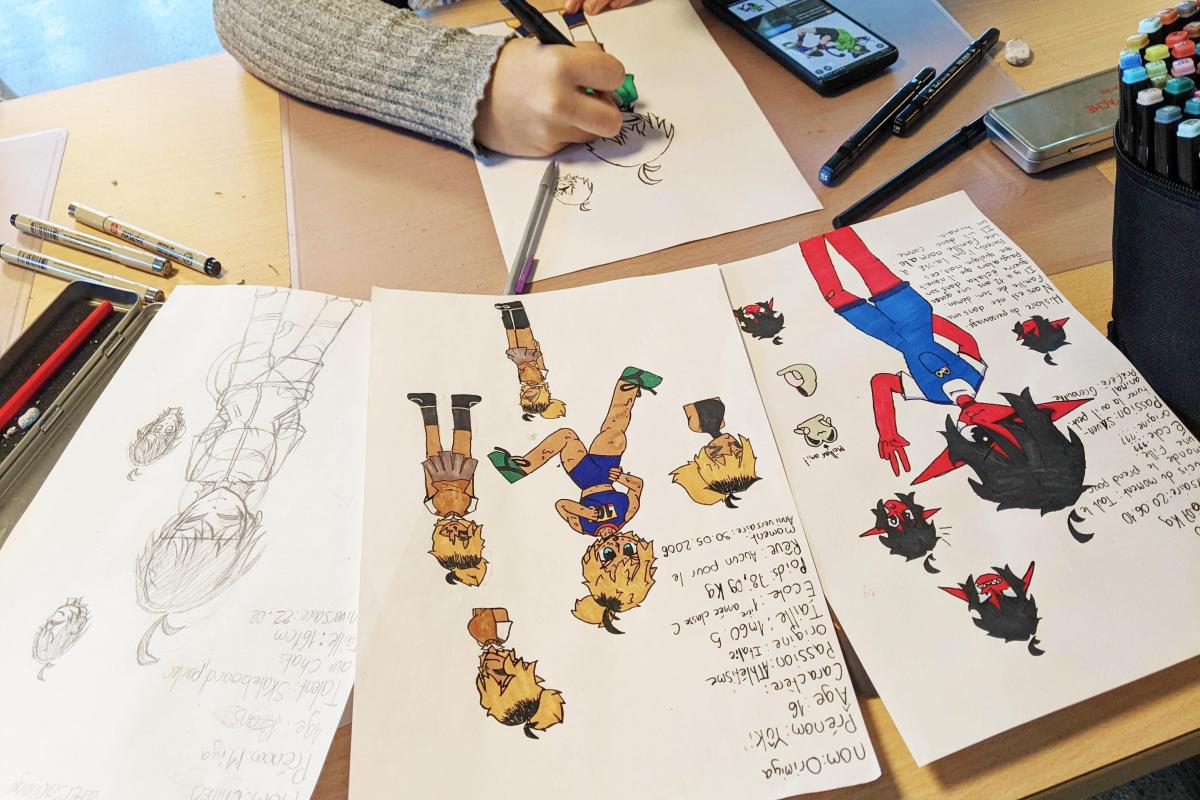
A serious manga course relies on clear pedagogical progression. Students tame professional material that differs from usual supplies. The use of nibs, specific ink, screen tones, and alcohol markers becomes a ritual in the illustration process. Knowing how to manipulate these tools requires work and a lot of delicacy.
Beyond instruments, the techniques taught are vast and exciting. Teaching often begins with the study of facial expressions, mirrors of emotions, before addressing anatomy. Understanding body mechanics is crucial to animate a manga hero. The course then explores perspective and backgrounds, aspects often dreaded by the beginner draftsman. This is where the support of a school makes perfect sense compared to the isolation of the autodidact.
Opening up to other mediums: Watercolor, Acrylic, and Oil
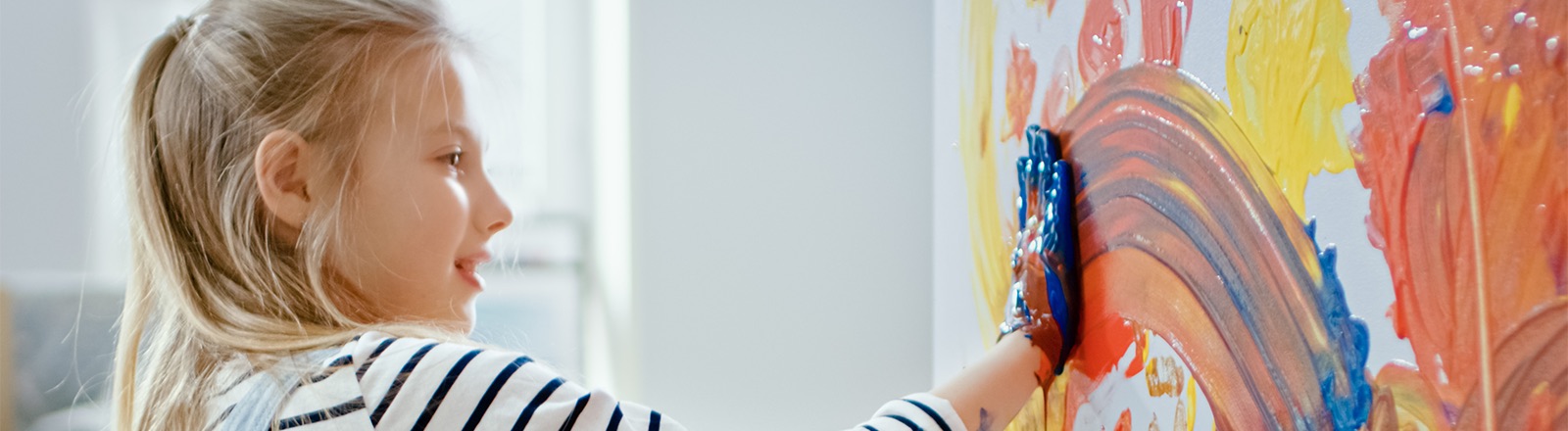
While manga favors black and white, mastering color is a major asset, especially for covers. A complete workshop will encourage students to test watercolor, ideal for its softness and luminosity. Other approaches like acrylic or oil painting can be presented to enrich the artistic culture of the young ones. Even charcoal finds its place to work on shadows and volumes. This diversity of mediums consolidates the child's baggage and initiates them to the fundamentals of plastic arts.
For those wishing to specialize further, our manga drawing course offers a curriculum dedicated to this graphic passion.
Adapted Formulas: School Year, Holidays, and Camps
Parents have several options to integrate this art into daily life. The weekly course, followed during the school year, ensures stable progression and a bond of trust with the teacher. It is the ideal format to install a soothing work routine. However, holiday periods open the door to another dynamic: camps.
An intensive camp during the holidays allows for total immersion in creation. Over a week, children dive into their universe, often with the goal of creating a small booklet. These camps meet with vivid success in cultural cities like Geneva. It is an excellent way to validate the child's interest before committing for the year. Our Holiday camps offer precisely these unforgettable creative parentheses.
Online, at home, or at school?
The learning framework plays a key role. The art school offers social emulation and adapted equipment. The course at home allows for a tailor-made approach but may lack group energy. The online option offers precious flexibility for families far from centers like Geneva. Each formula has its virtues, but the direct relationship with a teacher and other enthusiasts in a physical workshop often remains the liveliest method for a child.
At what age to start? Levels and Audiences
It is natural to wonder if a toddler or a baby can be initiated into drawing. While awakening is crucial, a real manga course requires fine motor skills that stabilize around 7 or 8 years old. Unlike sensory games for a baby, manga demands technical precision adapted to older children and adolescents.
Sessions are often divided by levels: beginner, intermediate, and advanced, allowing the teacher to adjust their pedagogy. An intermediate level student will be able to deepen complex narration, while a beginner will focus on anatomical bases.
A passion for all: Adults and duos
Manga transcends ages. There is a real demand for the adult course. Sometimes, the desire to learn is lived as a parent-child pair to share a complicit activity, or even as a pair of friends wishing to discover a common hobby. These intergenerational workshops are precious moments of sharing. Although pedagogy for an adult is more analytical than for a child, the objective remains the same: to find fulfilling teaching adapted to one's skills.
Artistic Education: Skills and Future
Investing in a manga course is a strong educational choice. Beyond pleasure, it is training that builds solid skills: sense of narration, composition, color theory. This knowledge is an asset for many professions in the visual arts. For adolescents dreaming of a career, these courses seriously prepare for the exams of higher art schools.
Confirmed artists often intervene in schools to share life and technique advice. They remind us that talent blooms thanks to work. The learning of drawing is a journey that teaches resilience. Quality artistic education prepares students for critical analysis and the constant evolution of their practice.
To widen their expressive palette, students can explore other disciplines, such as the theater course to better grasp character emotions, or the music course to rhythm their scenarios.
Materials and Investment: Preparing the Artistic Start
When enrolling your child in a course, the question of material is legitimate. Unlike oil or acrylic painting requiring expensive supports, manga starts with lighter equipment. However, for a polished result, acquiring quality markers and paper adapted to ink work becomes necessary throughout the year.
Schools often make material available during the workshop, but owning one's own kit at home encourages practice. The benevolent advice of the teacher will guide purchases to avoid the superfluous. If the student explores mixed techniques like watercolor or charcoal, the material will adapt. As the digital era is unavoidable, many camps also integrate initiation to graphic tablets for illustration.
Choosing the Right Teacher and the Ideal School
The meeting with the teacher is decisive for your child's learning. An ideal mentor combines technical expertise and encouraging pedagogy. They know how to navigate between the different levels of the group so that everyone progresses. In dynamic cities like Geneva, the offer varies from the local association to the private institute. Verifying the background of teaching artists and the program structure is essential.
A quality school will propose a clear path with objectives for the year, while offering the pride of exhibiting one's works. Annex cultural activities considerably enrich artistic education. Whether one chooses the online, at home, or in-class format, human warmth and technical expertise within the workshop remain the keys to success.
For those still hesitating on the specialty, a generalist visual arts course can be a wonderful introduction before dedicating oneself to manga.
Preparing Creative Holidays
The arrival of the holidays is the dream moment to plan activities that change from the daily routine. Manga camps offer an exciting alternative to classic daycare. They allow for forging bonds with other young creators. These intensive camps favor rapid and rewarding technical breakthroughs.
In Geneva and French-speaking Switzerland, these sessions are highly prized. It is prudent to book early. Whether to perfect a precise technique like watercolor in manga or to try one's hand at scriptwriting, these moments accelerate learning. They are also the ideal occasion to test the atmosphere of a school before a year-long enrollment. For teens, it is a full-scale test of their motivation for the arts.
Conclusion: Art as a Vector of Personal Fulfillment
Enrolling your child in a manga course is valuing their imagination while teaching them rigor. It is offering them a space of freedom where technique becomes the servant of their intimate expression. Whether it is a passionate hobby or a future project, the benefits on confidence, concentration, and creativity are immense.
The options are vast, from the weekly course to holiday camps, without forgetting online support. The essential thing is to support the child in their approach and provide them with the tools to grow. Drawing is a universal language, and manga is a vibrant form of it. By mastering illustration, the student learns to cast a new and sensitive gaze on the world.