The Evolution of Manga Art and Technical Requirements in 2025
As we reach the end of 2025, the world of manga continues to amaze us with its richness and depth. What was once perceived as a simple hobby has become a full-fledged artistic discipline, capable of transmitting intense emotions. For our children as well as for older enthusiasts, drawing is not just a mechanical act, it is a language of the heart. However, for this language to be clear and touching, it requires real background work. Moving from a sketch scribbled in a school notebook to a manga page vibrating with energy requires patience, humility, and an intimate understanding of materials.
The learning of drawing is a journey. Whether you are a beginner with bright eyes or an intermediate level drawer looking to refine your voice, the mastery of technique is the key that opens the door to freedom. Creativity is the engine, but it needs solid rails to move forward. In our schools or during an immersive workshop, we observe this magical transformation every day: the moment when the student stops suffering their tool to finally use it as an extension of their mind. This is where the artistic approach takes on its full meaning, transforming a raw passion into precious skills for life.
The Essential Materials for Mangaka Work
Touching the paper, feeling the texture under the hand... The choice of materials is a crucial sensory step. To honor your work, printer paper is no longer enough. You must offer your creations a worthy support, such as layout or Bristol paper, which will welcome the ink gently without letting it run. It is an indispensable traveling companion for your entire year of creation.
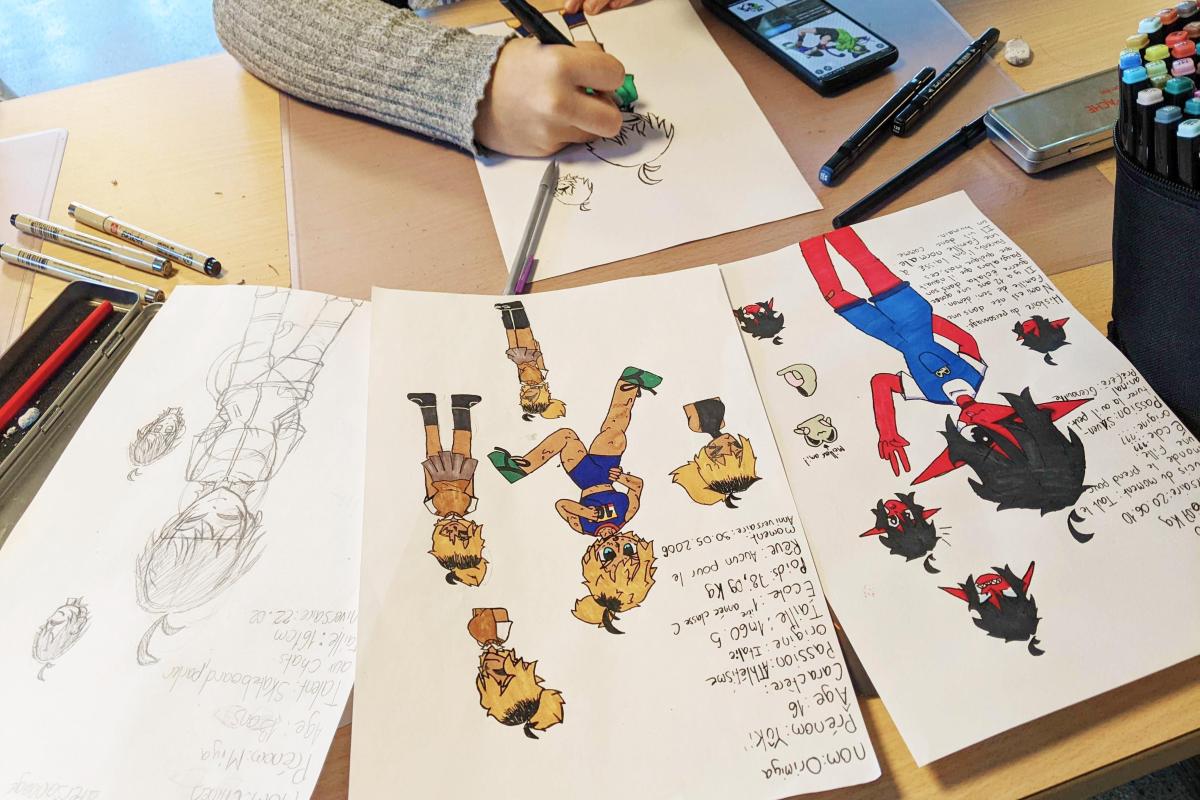
In the warmth of a studio, one quickly learns that every tool has a soul. While calibrated felt-tips reassure the child who is starting, the nib remains the Holy Grail of the mangaka. The G-pen or Maru-pen requires a demanding learning process, almost musical. It reacts to pressure, modulating the thickness of the line as one modulates their voice. It is this unique vibration that breathes life into the drawing, an emotional nuance that a ballpoint pen can never equal.
Tool Comparison: Choosing Your Medium of Expression
Each technique tells a different story. Charcoal, for example, is wonderful for academic sketching, offering dramatic shadows and a particular grain. However, charcoal is rarely the ally of manga, because it is too untamable for the precision of panels. Conversely, Indian ink offers that deep black clarity, essential for visual narration.
Color is also a vector of emotion. If oil painting is venerated in schools of fine arts for its rich texture, it is ill-suited to the fast rhythm of manga due to its slow drying. Acrylic is an interesting alternative for striking covers. But for softness and reverie, watercolor remains the favorite of artists. Mastering watercolor means learning to dialogue with water, creating luminous illustrations that seem to breathe. It is a technique that we strongly encourage to develop chromatic sensitivity.
The Art of the Line: Mastering Line and Inking
Inking is the moment of truth, the instant when the drawing asserts itself. It is a work of self-confidence. A beautiful line must not tremble; it must carry the artist's intention. In a class or a studio, the benevolent gaze of the teacher helps to overcome the fear of "ruining" the drawing. One learns that hesitation is normal, but that the gesture must remain fluid.
For children, this step is a great life lesson: one cannot erase ink, one must assume one's choices. This education through the line forges character. It is thanks to this rigor that personal style is revealed. Your style is your emotional signature, the way your hand dances on the paper.
Creativity through Technique
It is fascinating to see how constraint releases creativity. When the hand no longer struggles against the pen, the mind can focus on the story. Camps during the holidays are perfect time bubbles for this click. Far from daily worries or the school rhythm, the student can totally immerse themselves. Often, a week of intensive group practice is worth months of solitude at home.
Learning Manga: Weekly Classes or Holiday Camps?
Each artist has their own rhythm to learn. Weekly classes, followed throughout the year, offer a reassuring structure and gentle progression. It is a meeting with oneself and one's teacher, where one builds stone by stone. It is ideal for deep and lasting learning.
In contrast, camps during the holidays are passion accelerators. Whether in Geneva or elsewhere in French-speaking Switzerland, these moments are explosions of creativity. For children, it is the opportunity to create a complete illustration or a short story, feeling the pride of completion.
The Importance of the Studio Environment
The energy of a studio is contagious. Drawing alone at home is necessary, but sharing one's doubts and victories with other artists creates positive emulation. Seeing the work of the neighbor, exchanging advice, that is also the school of life. It is a place where one feels understood, surrounded by people who share the same visual language.
What Age to Start? Tips for Children, Teens, and Adults
Art has no age, because the desire to create is universal. Of course, a toddler of 4 years old will not do complex perspective, but their sensory awakening in adapted workshops prepares the ground. True manga classes often start around 8 years old, when the child can conceptualize volumes.
Adolescence is often the moment when manga becomes a refuge, a way to express what words cannot say. The school must be this sanctuary where one does not judge, but where one guides.
But we also see more and more adults crossing the threshold of our classrooms. Sometimes for themselves, sometimes as a couple to share an activity, or even as a family to weave bonds differently. The adult brings a different reflection, often more analytical, but they must relearn to play like a child. Our activities adapt to each age to develop specific skills, whether for pleasure or to prepare for higher education exams.
The Advantage of a Caring Teacher
Why join a structure when everything seems accessible online? Because a teacher does not only give you the technique, they give you confidence. They correct your posture, show you how to hold your tool, something impossible at home. In our schools, each student is unique and receives advice adapted to their level, whether they are a beginner or intermediate.
Live teaching also allows for exploration. A professor can let you taste watercolor, explain why oil is different, or have you test charcoal to understand light. This diversity nourishes your manga art. Preparation for artistic exams or building a solid school portfolio requires this expert and human accompaniment.
Levels and Fulfillment
Pedagogy must be progressive. The beginner tames shapes, the intermediate level explores space and movement. This structure reassures the child as well as the adult, proving to them that they are capable of progressing. The skills acquired, like patience and observation, radiate well beyond the course, even helping in the classic school path. Artistic education is a school of sensitivity.
Beyond Black and White: Color as Emotion
If black and white is the skeleton, color is the soul of the illustration. Watercolor is magnificent for this, requiring one to let go and accept the unexpectedness of water. It is an excellent school of humility. Acrylic can bring strength, but watercolor remains the queen of poetry in manga.
It is enriching to see how techniques respond to each other. The experience of oil can enrich digital coloring, just as the practice of charcoal refines the perception of contrasts. In Geneva and throughout the region, we train curious and versatile artists.
Holiday Camps: A Human Adventure
The holidays are made for dreaming, and what better than a camp to make one's dreams come true? Freed from school homework, young people can draw for hours on end. This immersion creates strong bonds and unforgettable memories. It is an enchanted parenthesis where only creation counts.
These camps allow you to try everything: a day on the line, another on color (watercolor or markers). It is an ideal complement to classes followed throughout the year. For families, it is the guarantee that their children experience enriching holidays, developing their imagination and their manual skills.
Towards a Fulfilled Artistic Practice
In summary, the path of manga is a beautiful adventure that demands heart and perseverance. Que you choose regular classes throughout the year or the intensity of camps, the essential thing is to keep the joy of creating. With the right materials, a progressive mastery of techniques like the line and watercolor (or even acrylic), and the advice of a passionate teacher, everything becomes possible.
Do not remain alone with your doubts at home. Join a community, open yourself to teaching and share your vision of the world. Apolline Ecole d'Arts offers this caring accompaniment through its BD & Manga drawing courses and camps in Geneva and throughout French-speaking Switzerland.