Starting the musical adventure: The piano landscape in 2026
Feeling the vibrations of a note under your fingers, understanding the universal language of emotions, or simply escaping the daily grind: the desire to learn piano often answers a deep inner call. In this month of February 2026, the Vaud capital vibrates with a new creative energy, offering an ideal playground for future music lovers. Whether you are a parent looking to awaken the artistic sensitivity of your children or an adult wishing to finally realize a suspended dream, the quest for the right piano lessons Lausanne marks the start of a personal transformation.
Music is much more than a simple extracurricular activity or a hobby; it is a discipline that sculpts the mind, soothes the heart, and nourishes the soul. However, navigating the ocean of possibilities can prove complex. Between the perceived austerity of the conservatory, the flexibility of private schools, and the abundant offer of home lessons, it is natural to feel hesitant. This guide aims to accompany you with kindness in your pedagogical reflection in Lausanne.
Our goal is to demystify the available approaches, from rigorous classical to the expressive freedoms of jazz, so that every style finds resonance within you. We will address practical realities without taboo: the investment in CHF, the real place of music theory in learning, and the capital importance of the relationship with your teacher. Today, access to quality musical training has become democratized, allowing every level, from the absolute beginner to the intermediate pianist, to find their path to fulfillment.
How to direct your search for piano lessons in Lausanne?
To choose your piano lessons Lausanne serenely, start by listening to your aspirations. Are you looking for the reassuring structure of academicism or the immediate pleasure of discovery? The quality of teaching often rests on the teacher's qualification; verifying the diploma of your future mentor is a pledge of security. Finally, compare the price offers in CHF and favor a school that values authentic reviews and a human-centered pedagogy.
The Classical Approach: Rigor, Music Theory and Deep Emotions
The path of classical is often perceived as the royal road, the one that builds the most solid foundations for musicians. It relies on structured learning, where respect for the text and reading sheet music are central. In Lausanne, this tradition of excellence is carried by passionate teachers, often holders of a master's degree, who transmit a centuries-old heritage. For a beginner, this rigor may seem intimidating, but it is the key to future technical freedom.
Far from being an arid constraint, music theory is here the tool that allows deciphering masterpieces. Viewing theory as a necessary grammar allows one to better appreciate the poetry of practice. In a course oriented towards the classical repertoire, attention is focused on posture, breathing, and the infinite nuance of touch. It is a training that demands patience, but offers in return the capacity to express emotions of rare subtlety.
For children, this curriculum is often marked by stages, or levels, which validate progression and reinforce self-confidence. For adults, classical proposes a stimulating intellectual challenge and an intimate connection with art history. If your heart beats for Chopin or Debussy, surrounding yourself with an expert teacher in Lausanne will be your best asset to make the instrument sing.
Jazz and Contemporary Music: The Art of the Moment and Creativity
If your soul vibrates more for spontaneity, jazz and contemporary music offer a fascinating pedagogical alternative. More and more students in Lausanne acclaim these styles for their direct and convivial approach. Here, the piano lessons Lausanne become a laboratory of experimentation. The teaching often privileges the ear, active listening, and improvisation before the strict reading of notes.
At the heart of this approach lie creativity and composition. Rather than reproducing faithfully, the student learns to understand harmony, to play with chord charts, and to invent their own musical phrases. It is the ideal method for those who dream of joining a musical group. The modern pianist is not an isolated soloist; they dialogue with the guitar, support the singing, and interact with the rhythm section.
This approach favors a pleasure of playing that is often faster. A beginner can, in a few minutes of daily practice and guided by an inspiring teacher, accompany songs they love. This does not exclude high standards: the sense of rhythm and listening to other musicians require great concentration. For those whom the atmosphere of the conservatory might restrain, this openness proposed by certain schools in Lausanne is a breath of fresh air.
Children or Adults: A Pedagogy that Adapts to Life
Age is just a number, but it influences the way we receive information. A course intended for children cannot be a carbon copy of a lesson for adults. Lausanne pedagogues have understood this well and modulate their approach to touch the sensitivity of everyone.
Wonder and discovery for the child
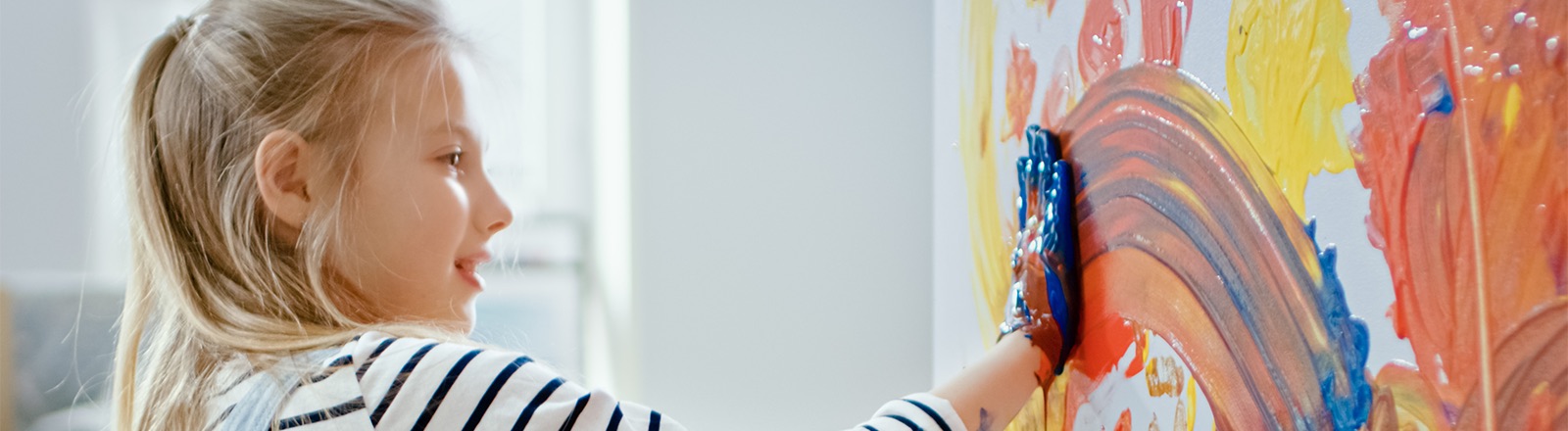
For the youngest, music must remain a celebration. Learning is built through play, imagination, and sound exploration. The duration of sessions is often adjusted (30 or 45 minutes) to respect their attention span. The primary objective is to anchor the pleasure of making music without creating blockages. The teacher acts as a benevolent guide, introducing music theory through body rhythm and singing. To prolong this playful immersion during school holidays, the artistic Holiday Camps are a wonderful opportunity to experience music in a community.
The adult's journey: overcoming fears
Let's take the example of Marie, one of our fictional but so representative students. At 35, she thought it was too late to learn. This is a stubborn preconceived idea that must be deconstructed. Adults possess intrinsic motivation and an analytical capacity that largely compensate for lower initial motor plasticity. Their lessons are often moments of "breathing" in a dense active life. The pleasure of playing for oneself becomes an outlet for stress. Teachers then build the program with the student, integrating pieces of jazz, pop, or film music, adapted to an intermediate or beginner level, to guarantee immediate satisfaction.
Choosing Your Mentor: Beyond the Diploma, the Human Encounter
The quality of the student-teacher relationship is the true secret of success. In Lausanne, the offer is vast, ranging from the student private tutor to the seasoned pedagogue. How to sort through it? While the diploma validates technical skills, it says nothing about empathy or the capacity to transmit. The human experience is paramount.
An excellent teacher is one who knows how to listen to your doubts and adapt their method to your personality. They do not roll out a fixed program; they co-construct your path. During your search for piano lessons Lausanne, demand a trial lesson. It is the moment of truth to feel if confidence is established. Joining a structured music school often offers the guarantee of a monitored and coherent pedagogical team, where ads from private individuals can sometimes reserve uneven surprises.
The learning setting also plays a role. Although home lessons offer logistical comfort, moving to a dedicated structure allows playing on exceptional instruments (grand pianos, professional keyboards) and immersing oneself totally in one's creative bubble. The reviews of other families are often a reliable indicator to unearth these rare pearls among teachers.
The Power of the Collective: Playing in a Group
In 2026, the trend is towards sharing. The image of the solitary pianist repeating their scales in the shadows is over. Music is above all a social language, made to be shared. Integrating a musical group or a workshop is an experience that accelerates progression spectacularly.
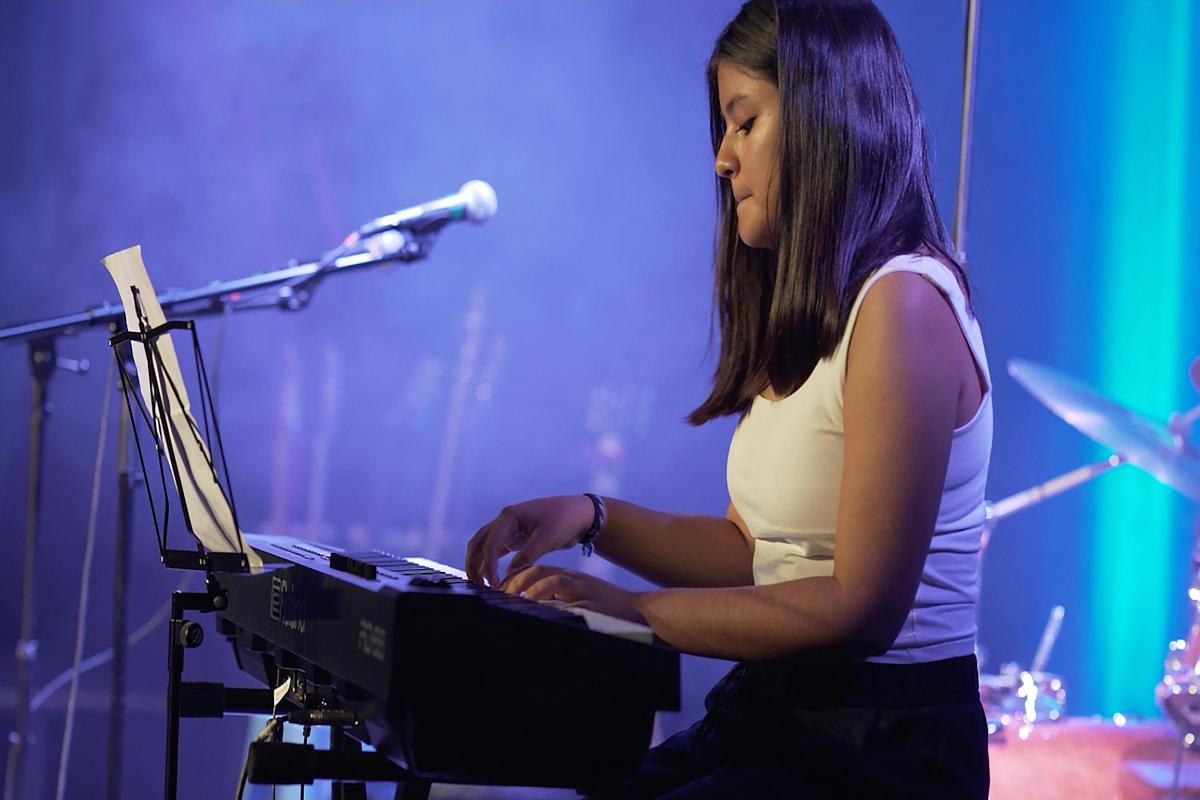
In Lausanne, modern pedagogies encourage this transversality. Playing with a drummer forces you to a new rhythmic rigor; accompanying a singing lesson develops subtle listening. It is in these interactions that the musician's identity is forged. For teenagers, starting a pop or rock band is often much more motivating than preparing for a formal audition.
This collective practice allows approaching theory from a concrete angle: understanding arrangement, managing sound balance with other instruments, finding one's place. It is a school of listening and respect. Our Music Lessons integrate this philosophy, encouraging students to meet and create together as soon as their level allows it.
Transparency and Reality: Prices in CHF and Organization
Let's calmly address the question of budget, as it is central to your decision. The price of lessons in Lausanne reflects the diversity of the offer. While informal private lessons may seem attractive, they often lack framework and continuity. Established schools propose a clear CHF fee schedule, corresponding to professional and declared services.
One must view this investment as a commitment to oneself. Formulas adapt to your availability: 30, 45 or 60 minutes. For a beginner, shorter but regular sessions are often more productive to maintain concentration.
Do not forget the material aspect. While buying an acoustic piano represents a significant cost (several thousand CHF), rental solutions or current digital pianos offer excellent alternatives to start. Your teacher will be able to orient you towards regional artisans to find the instrument adapted to your home and budget. Regular practice at home is indispensable to progress, and that starts with adequate equipment.
Your Musical Journey Starts Today
In conclusion, whether your heart swings for the nobility of the classical repertoire or the liberating energy of jazz, Lausanne offers a rich ecosystem for your musical fulfillment. The essential thing is to find the environment that respects your rhythm, your fears, and your dreams. Artistic training is a journey, not a race.
Do not let old clichés about music theory or age deprive you of this joy. With today's benevolent pedagogies, learning piano is a door open to all. Dare to take the first step, go meet passionate musicians and let music color your life. The benefits on your emotional balance will be immense.
For those seeking this alliance between high standards and kindness in the heart of Lausanne, Apolline School of Arts offers a modern approach to piano lessons, but also Manga Drawing Lessons to vary creative pleasures. Our structure offers weekly lessons (singing, guitar, piano, drums, bass) exclusively in Lausanne, with rates starting at 111.- CHF per month, designed to sustainably accompany your artistic fulfillment.