
Authenticity in the Digital Age: More Than Just a Trend
At the start of this year, January 2026 marks a decisive turning point: we have all become, in one way or another, content creators. Yet, faced with the artificial perfection of digital avatars, the public now seeks a raw and sincere connection. This is where the work done in a drama school takes on its full meaning. Taking theater classes is no longer just a cultural activity; it is true training in emotional intelligence and presence, essential for anyone wishing to captivate an audience.
Whether in Lausanne or Geneva, knowing how to manage one's image and emotions has become a key skill. A year of theatrical practice offers much more than the preparation of a show; it forges unshakable confidence. This investment in oneself, whose value far exceeds the cost in CHF, allows you to break the ice, whether on a real stage or in front of the intimidating lens of a smartphone. Acting is the ultimate tool to transform a simple video into a moment of authentic sharing.
Why Theatrical Technique Enhances Video
There is a common misunderstanding: it is often thought that acting for the camera and improvisation on stage are two opposing worlds. Pedagogically, this is a mistake. Rigorous training in theater classes constitutes the most solid technical foundation for successful video interventions. Work on the voice, for example, is fundamental. Learning to project your timbre without forcing, to articulate to be intelligible, and to nuance your remarks allows you to maintain the attention of those listening to you.
Self-confidence is built through experience and repetition. The classes offer a benevolent laboratory to test your limits. Improvisation, a pillar of learning, develops crucial mental agility. During a failed video take or an unforeseen live stream, this ability to bounce back with a smile, without losing your composure, is what distinguishes the amateur from the professional.
Moreover, body awareness is often the weak link for digital creators. In class, one learns to inhabit one's body, to anchor one's posture, and to eliminate parasitic gestures. This background work transforms your presence on screen. Workshops focused on body expression and emotions are therefore indispensable complements to give depth to your content.
Children and Teenagers: Transforming Energy into Art
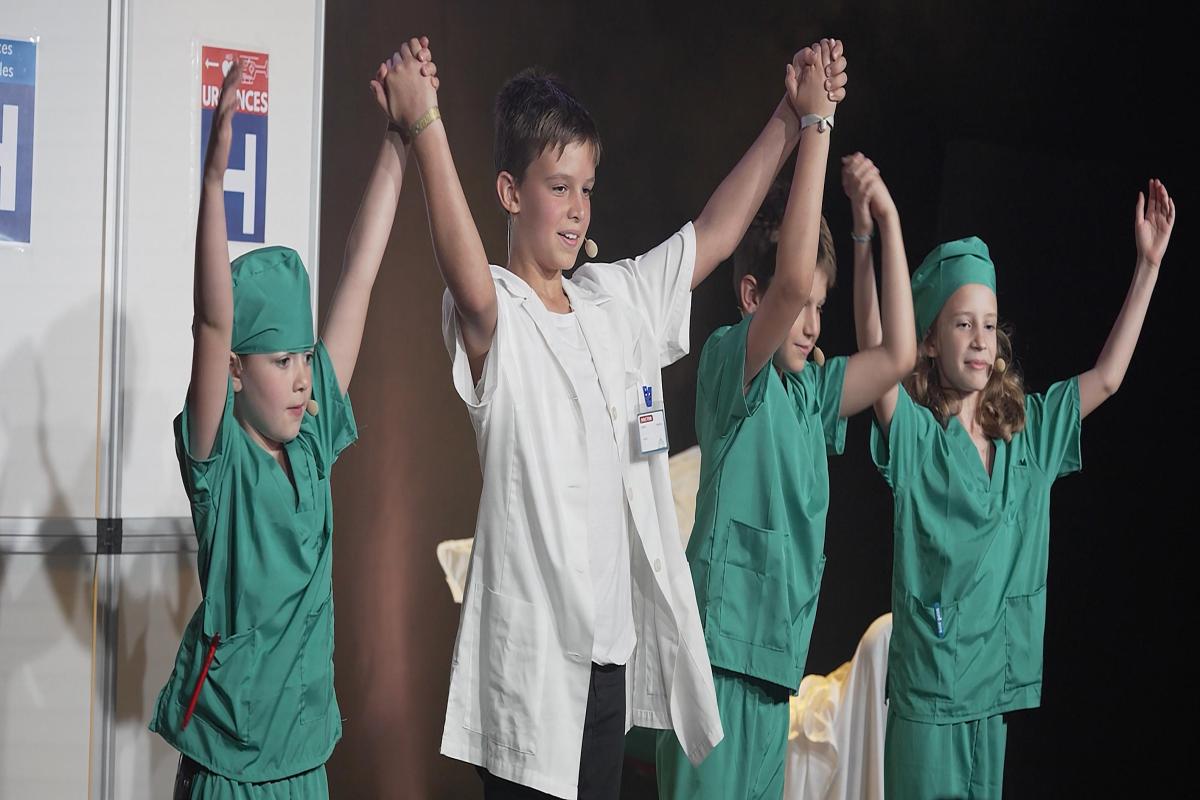
For children and teenagers of the 2026 generation, the image is a native language. Enrolling them in theater classes allows them to move from the status of passive screen consumer to that of active and conscious creator. An arts school offers a structured framework where this overflowing energy is channeled towards a common artistic goal: the end-of-year show. It is a human adventure that goes beyond simple leisure.
Parents often observe a touching metamorphosis. The reserved child opens up to the world, while the very energetic child learns concentration and listening to others. For teens, often plagued by doubts about their image, theater is a saving outlet. The group becomes a second family where one learns to trust oneself and to trust partners. Unlike the isolation sometimes induced by social networks, theater celebrates the collective.
Artistic education plays a major role in emotional balance. Interpreting varied characters allows young people to explore a palette of emotions that they sometimes dare not express in daily life. Whether in the Canton of Vaud or elsewhere in Switzerland, theater classes for young people are designed to strengthen self-esteem at a pivotal age where identity construction is essential.
Adults and Beginners: Daring to Reinvent Yourself
It is never too late to get on stage. Classes for adults welcome varied profiles every year, from the absolute beginner to the long-time enthusiast. For an adult, joining a troupe is an excellent way to escape daily life while developing professional skills, notably public speaking ease. It is a space of freedom where judgment has no place.
In these workshops, the work is focused on letting go and authenticity. Improvisation holds a central place, as it forces one to live in the present moment and accept the unknown—a soft skill highly sought after in the world of work. The cost of registration, often a few dozen CHF per month, represents a minimal investment compared to the lasting benefits on stress management and personal leadership.
The group dynamic is the heart of this experience. Adults find a warm conviviality that is sometimes lacking in professional life. It is a place to explore different facets of one's personality. Whether to gain assurance or simply for the pure pleasure of acting, the experience of the stage brings an ease that radiates immediately into everyday life.
From Stage to Cinema: Nuances and Techniques
While emotions are universal, the techniques to transmit them differ between theater and cinema. A good school will teach you to navigate between these two worlds. On stage, the energy must be expansive to reach the last row of the public; facing a cinema or smartphone camera, the lens captures the slightest quiver. This is the subtle art of acting: knowing how to dose one's expression according to the medium.
The approach to texts also varies. In theater, one often respects a precise musicality and rhythm, while acting for the camera demands a disarming, almost conversational naturalness. Modern theater classes, notably those given in Lausanne, integrate these notions to train versatile actors. The interpretation of characters thus gains in finesse and credibility.
Understanding these mechanisms also allows one to become a more informed spectator. One no longer watches a film or a play in the same way after having experienced the difficulty of making a scene credible oneself. French-speaking Switzerland is full of inspiring performance venues to observe these techniques, thus nourishing the students' practice.
Choosing Your Format: Regularity or Intensity?
The choice of the ideal format depends on your personal objectives and your schedule. Weekly classes allow for gentle and constant progression throughout the year. It is the ideal format to build lasting confidence and prepare a polished show. The monthly rate is designed to be accessible, often starting around 79.- CHF for one hour, 89.- CHF for 75 minutes, or even 99.- CHF for longer sessions, which allows adapting the investment to one's budget.
For those looking for total immersion or a quick discovery, workshops during holidays are a fantastic option. These intensive weeks allow for a significant technical leap. It is often the ideal occasion for a child or teen to test the activity before committing. The Holiday Camps offer a strong human experience, creating unique bonds of friendship in a few days.
In terms of budget, a full one-week workshop can vary between 290.- CHF and 500.- CHF depending on the location and options chosen. It is excellent value for money to intelligently occupy young people with enriching activities. Whether in a weekly workshop or intensive course, the important thing remains the regularity of work and the pleasure taken in learning.
Cultural Offerings in French-speaking Switzerland: Lausanne, Geneva and Surroundings
French-speaking Switzerland is fertile ground for quality artistic education. The Canton of Vaud, and particularly Lausanne, concentrates a very rich pedagogical offer. Finding a passionate and qualified teacher is easy there. Local art schools offer varied curriculums, ranging from classical theater to modern musical comedy. Geneva is not to be outdone, with a dynamic international scene that positively influences teaching methods.
Rates remain competitive for the level of excellence proposed. Count on average between 80.- CHF and 120.- CHF per month for classes supervised by professionals. In Lausanne, the proximity to major theatrical institutions creates a particular emulation for students. They often have the opportunity to draw inspiration from professional plays, which nourishes their own creativity.
In cities like Yverdon, Montreux, or Neuchâtel, the offer continues to develop to meet the growing demand of families. It is no longer necessary to travel long distances to find top-level training. The emphasis is on proximity, allowing every child or adult to practice their art near home, thus facilitating the logistical organization for parents.
The Impact of Theater on Academic and Professional Paths
The benefits of theater extend well beyond the stage. In the academic environment, teachers often remark that students practicing theater participate more orally and structure their thoughts better. The ability to memorize texts trains memory, while the psychological analysis of characters develops empathy, a major asset for literary and human subjects.
For adults, these skills are directly transferable to the corporate world. Stress management before an important meeting looks strikingly like stage fright before entering the stage. Knowing how to bounce back from an unexpected question from a client is a form of applied improvisation. This is why many companies now invest thousands of CHF in theatrical training for their teams, conscious of the return on human investment.
Education through theater also favors active listening, a rare quality. On stage, if one does not listen to one's partner, the scene collapses. It is identical in a professional project. Learning to accept others' proposals ("Yes, and..." rather than "No, but..."), is the basis of collective intelligence and a healthy group dynamic.
Creativity: The Engine of Your Future Success
In 2026, creativity is no longer an option, it is a necessity. Theater workshops are safe laboratories where one has the right to be wrong, to try, to invent. This freedom nourishes the spirit of innovation necessary in all fields. A child who learns to create imaginary worlds will be an adult capable of finding original solutions to complex problems of tomorrow.
Conclusion: The First Step Towards Your Audience
Embarking on theater classes is a courageous and deeply enriching step. Whether you reside in Lausanne, Geneva, or elsewhere in the region, opportunities to discover oneself are not lacking. It is a journey towards better self-knowledge, greater confidence, and an increased capacity to communicate authentically with the world.
The investment in time and CHF is quickly paid off by the richness of human encounters and the pure joy of artistic practice. Do not let the fear of judgment or the feeling of being a beginner hold you back. The public is benevolent, and your acting partners are there to support you at every step. A year of theater can positively change your perception of yourself for life.
So, whether you aim for a career in cinema, dream of becoming an influential content creator, or simply want to be more at ease in your interactions, theater is the key. The work of the actor is above all a work of humanity. Apolline offers a multidisciplinary and benevolent approach to accompany each student.