
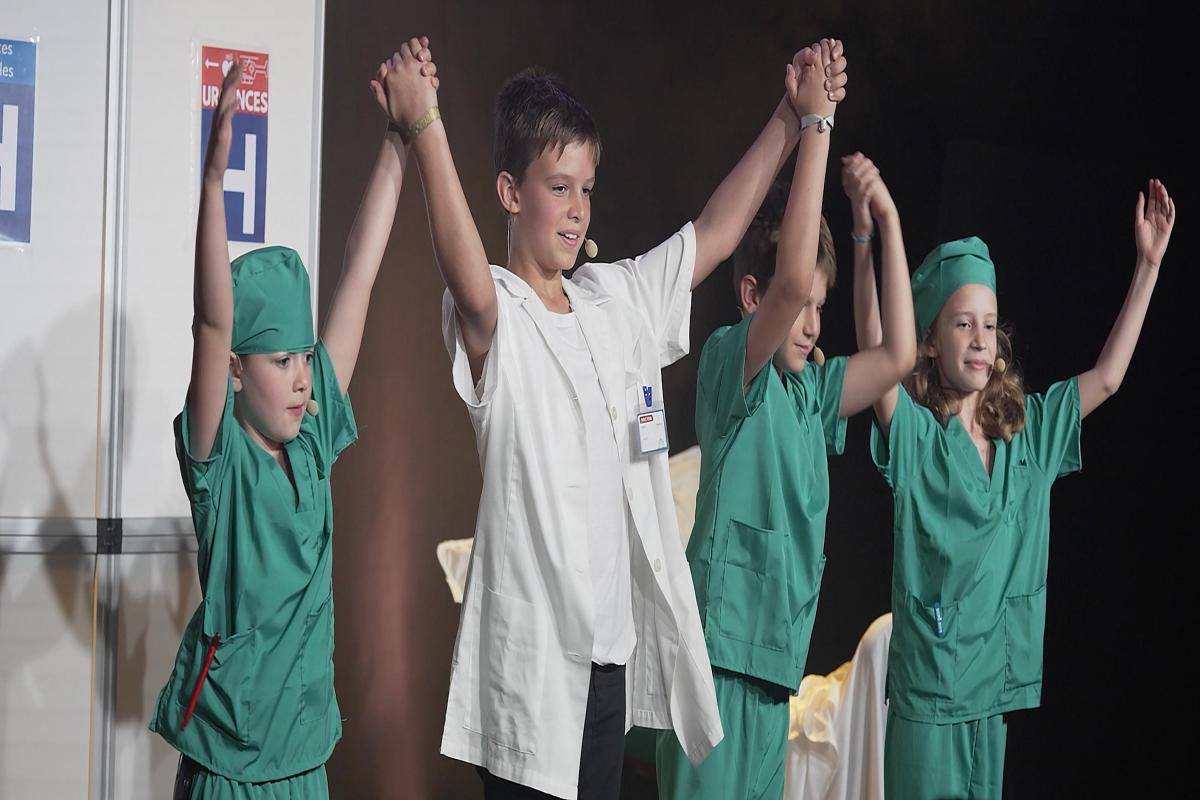
It is November 28, 2025. Outside, the digital world never sleeps, saturated by artificial intelligence and incessant notifications. Inside our homes, the challenge is significant: how to find genuine human connection again? Transforming your living room into a lively theater stage has become, for many, the ideal antidote to this digital fatigue.
It is November 28, 2025. Outside, the digital world never sleeps, saturated by artificial intelligence and incessant notifications. Inside our homes, the challenge is significant: how to find genuine human connection again? Transforming your living room into a lively theater stage has become, for many, the ideal antidote to this digital fatigue. Far from being a simple distraction, home improvisation stands out as a pedagogical tool of rare power, accessible to all and totally free (0 CHF), allowing children, teens, and adults to gather in a bubble of shared creativity.
Unlike cinema, where we are passive spectators of stories written by others, domestic theater invites every member of the family to become the author and actor of the present moment. Whether you live in the heart of Lausanne, near Geneva, or in a remote village in Switzerland, all it takes is a spark of imagination to create a unique show between the sofa and the coffee table. This article aims to guide you, with kindness, through simple yet profound exercises. We are going to transform a rainy afternoon into an enriching artistic experience, weaving confidence and team work into the heart of your home.
Why Improv is the Ideal Activity (0 CHF and 100% Fun)
Theatrical improvisation is much more than a game; it is a school of empathy and listening that offers immediate benefits, regardless of the age of the participants. For a shy child who dares not raise their hand in class or an anxious beginner afraid of exposing themselves, it is a playful and safe way to break the ice. The work done through play allows one to unlock speech, tame one's body, and dare to express oneself without the paralyzing fear of judgment.
Zero Investment for Maximum Human Gain
Starting a small improvisation workshop at home has an undeniable practical advantage: it costs absolutely nothing, exactly 0 CHF. Unlike signing up for an elite sports club requiring expensive equipment, or certain costly cultural outings in Geneva or Lausanne, theater is a stripped-back art. It requires only your presence, your body, and your voice. It is a democratic and pure activity, which values the art of the moment: no long texts to memorize, just the joyful spontaneity of free expression.
Strengthening Precious Bonds Between Parents and Children
Parents often look, sometimes desperately, for ways to maintain dialogue with their adolescents. Theatrical play has this magical virtue of breaking down habitual family hierarchies. On the improvised stage of the living room, the teacher is no longer the parent dictating the rules, but the game itself. It is a rare occasion for young people to see their parents let go, accept ridicule, make faces, and step out of their authority role. This moment of shared vulnerability strengthens mutual confidence and creates imperishable emotional memories, far more striking than an evening spent individually in front of a screen.
The Rules of the Game: Kindness and Listening
Before diving into the improv exercises, it is crucial, like any pedagogical approach, to establish a safe framework. Theatrical training, even amateur, can only bear fruit if it rests on strict rules of conduct. For the magic to happen, the group (your family) must solemnly adhere to two fundamental principles.
First, the "Yes, and..." rule. In improvisation, one never refuses a proposal. If your child decides the rug is a river of molten lava, you cannot say "No, it's a rug". You must accept this reality and build upon it ("Yes, and look, there's a crocodile approaching!"). Second, the absolute benevolence of the audience. Even if the audience consists only of the cat or a brother sitting on the sofa, no mockery is allowed. This emotional safety is the key for sincere emotions to be expressed. This is exactly the climate of trust we strive to create in a good theater school, whether located in the Canton of Vaud or elsewhere.
5 Improvisation Exercises for All Ages
Here are five games designed to be universal, accessible to children as well as adults, and requiring no prior experience. They touch gently upon the different facets of acting: connection to others, body mastery, voice, and unbridled imagination.
1. The Mirror (Listening and Mimicry)
This exercise is a classic for a reason: it forces total connection. Two people face each other, eye to eye. One is the leader, the other the reflection. The leader moves very slowly, and the reflection must reproduce every gesture, every micro-facial expression instantly, like in a real mirror.
The pedagogical approach:
The goal is to develop intense concentration and deep non-verbal connection. It is perfect for calming and recentering a group of slightly agitated children. It is excellent work on bodily interpretation without needing scripts, allowing the youngest to understand that the body speaks as much as the mouth.
2. The Magic Box (Imagination and Mime)
Place an imaginary box in the center of the room. Invite each participant to approach, open the box with care, and take out an invisible object that they must mime with precision. The others must guess what it is. It could be a light feather, a heavy anvil, or a lively, squirming animal.
The emotional approach:
The challenge is to work on the precision of gesture and the weight of objects (the physical "medium"). It is very fun for young children from 4-5 years old who love materializing their thoughts. For older ones and teens, encourage them to choose complex or abstract objects to spice up the game and stimulate their creativity.
3. The Alphabet Dialogue (Repartee and Vocabulary)
Two actors improvise a small scene, but with a significant constraint that forces the mind to stay agile: each line must imperatively start with the next letter of the alphabet.
Example in action:
Player A: "Always look where you are going!"
Player B: "But I am looking, I have the situation under control."
Player A: "Clearly you don't, because the floor is slippery..."
The educational benefit:
This exercise stimulates quick thinking and active listening. It is excellent for teens and adults who like cerebral challenges, as well as for the playful education of younger school-aged children. It is a roundabout and joyful way to review the alphabet and enrich vocabulary, a scholastic supplement far more fun than classic homework.
4. The One-Word Story (Group Cohesion)
The whole family sits in a circle. The goal is to tell a common story, but with a strong constraint: each person can say only one single word at a time, going clockwise.
Example of narration:
Once - upon - a - time - a - little - dragon - who - loved - eating - pizza.
The life lesson:
The objective is to learn to build a narrative together (collective workshop spirit) rather than trying to impose one's personal idea. The challenge is to keep grammatical and narrative coherence, which often ends in liberating bursts of laughter, allowing positive emotions to circulate freely among participants.
5. The Emotion Bus (Characters and Acting)
Arrange chairs in rows like in a bus. A driver is seated at the wheel. A passenger enters with a strong emotion or a marked character trait (e.g., furious, extremely shy, or acting like a diva). The rule is simple but powerful: all passengers already present on the bus (as well as the driver) must immediately adopt this same emotion, like a contamination.
Why it is important:
This allows for the exploration of emotional contagion and the instant creation of characters. It is ideal for a large family or a group of friends. Note that this is an exercise often practiced seriously in professional classes in Lausanne to work on acting flexibility and empathy.
From Home to Art School: Going Further
If these games reveal a budding passion in your child or your teen, or if they allow a shy youngster to blossom, it may be interesting to consider more structured training. Home theater is a wonderful introduction, but a genuine weekly class offers incomparable depth and technical progression.
The Invaluable Contribution of a Qualified Teacher
An experienced and kind teacher will know how to guide the student to transform a natural aptitude into true talent. In an art school worthy of the name, the work is done over the duration of a full academic year. The student learns to place and project their voice, analyze more complex scripts, and understand the fine psychology of characters. The dynamic of a regular workshop with other students creates a social emulation impossible to reproduce alone. It is also the unique opportunity to confront a real audience during the end-of-year show, a key and often moving moment for building self-confidence.
Cultural Opportunities in French-speaking Switzerland
Western Switzerland is a land rich in cultural and pedagogical opportunities. Cities like Lausanne and Geneva are teeming with talent and structures. However, for continuous quality training centered on the human aspect, it is important to choose a structure that accompanies the student with real positive pedagogy. Whether you are near Geneva, La Côte, or Lausanne, access to quality classes is a major asset for the artistic education of your children. Rates often remain accessible, with options starting around a few dozen CHF per month, making art accessible to the greatest number. A good school will often propose trial classes to confirm the child's interest before any final commitment.
Camps and Holidays: Total Immersion
Sometimes, a year-long commitment can be scary for beginners or those with busy schedules. School holidays then represent the ideal moment to test the experience without pressure. Many establishments propose intensive camps during break weeks, offering a welcome creative interlude.
A Week to Create a Show and Discover Oneself
During these camps, often organized in the Canton of Vaud or near Geneva, young people experience total immersion in the world of performing arts. In the space of a week, they discover the basics of improv, stage work, and sometimes put on a small final presentation. It is an extremely popular formula among adolescents looking for stimulating social and creative activities during their time off. These camps allow them to meet new friends sharing the same interests, outside the usual school circle, and to develop new autonomy.
The particular intensity of a camp often allows for dazzling progress. The realization of one's own capabilities is often faster than in weekly classes because the student is immersed in the artistic bath from morning to evening. For concerned parents, it is also a smart childcare solution that nourishes the intellect, emotions, and creativity of their offspring, rather than leaving them inactive in front of a console.
Theater, a School of Life
In conclusion, whether through simple and joyful games in your living room or via formal enrollment in a reputable school, theater is, in essence, a fundamental school of life. It teaches listening to others, empathy, healthy management of emotions, and unshakable self-confidence. At a time when artificial intelligence is redefining our professional skills, these human "soft skills" are more precious than ever for the future of our children.
Do not wait any longer to transform your daily life and bring this touch of magic into your home. Try one of these 5 exercises this weekend as a family. And if the spark turns into a flame, remember that to go further, Apolline Ecole d'Arts proposes weekly theater and musical comedy classes in Lausanne, Yverdon, and Etoy from age 6, with rates starting at 79.- CHF per month, as well as holiday camps radiating throughout French-speaking Switzerland.