
Theatre in Morges: Understanding Your Child's Needs Between Script and Improvisation
As parents residing in the beautiful region of Morges, we all seek that spark in our children's eyes. That activity which won't be an additional constraint in an already busy school schedule, but a true breathing space. In this end of 2025, where digital pressure and performance are omnipresent, the need to return to authentic human exchanges is felt more than ever. Are you considering a theatre class for your child or teenager? It is a wonderful step. However, once the decision is made, a crucial pedagogical question often arises, leaving families perplexed: should I guide my little one towards a script interpretation workshop or towards the overflowing energy of improvisation?
It is not simply about choosing a Wednesday afternoon activity. It is about understanding which emotional environment will allow your child to fully flourish. Between the reassuring structure of an author's words and the dizzying freedom of the present moment, each discipline engages different psychological mechanisms. Whether you live in the centre of Morges or the surrounding villages, this choice deserves reflection. This guide aims to accompany you, with kindness and expertise, to decipher what really happens behind the curtain and find the ideal class that will help your young one grow this year.
The Interpretation Workshop: The Safety of Words to Build Oneself
The traditional image of theatre often evokes actors learning their lines before getting on stage. For a child, this approach known as "interpretation" offers much more than a simple memory exercise. It is a structuring framework, a reassuring architecture on which they can lean to dare to be someone else. In our workshops near Morges, we observe every week how the text becomes a refuge for sensitive personalities.
Structure as a shield against anxiety
Contrary to what one might believe, total freedom can be anxiety-inducing for some children. The work on a written text offers an essential safety net. The child does not have the responsibility of inventing what they must say; their mission is to understand and to feel. This distinction is fundamental. In an interpretation class, the written support allows attention to be channelled. For a student who is a bit scattered or anxious about the idea of speaking in public, knowing exactly which words will come out of their mouth is a liberation. They can then focus on the essential: the emotion and the relationship with their acting partner.
The character's inner journey
Interpretation is a school of deep empathy. By slipping into a character's skin, the budding actor learns to understand emotions that are not necessarily their own. It is a powerful pedagogical process that develops emotional intelligence. When a teenager plays a scene of anger or great joy written by an author, they explore these states in complete safety. They do not expose themselves directly; it is the "character" who lives the action. This distance allows young people from Lausanne or elsewhere to tame their own feelings without feeling vulnerable. The rehearsal work, week after week, allows this human understanding to be refined, transforming shyness into a force of subtle expression.
The joyful discipline of memory and body
One must not view learning lines as a school chore. In a quality workshop, memorising becomes a game of rhythm and music. It is a brain training that structures thought. In parallel, interpretation demands an acute awareness of the body and the voice. Knowing how to stand straight, projecting one's speech to reach the back of the show room, articulating with precision: these technical skills are gifts for the child's future life. They build a posture, a "presence" that will serve well beyond the boards, helping these future adults to take their place in the world with assurance.
Improvisation: The School of Letting Go and the Collective
At the other end of the pedagogical spectrum, improvisation seduces with its immediacy and freshness. Increasingly popular with families in Morges, this discipline rests on a radically different principle: everything is created here and now. For a child or a teen who needs to express themselves without a filter, it is an invaluable playground where error does not exist, because every "accident" becomes an acting opportunity.
The strength of the group and active listening
While the text can be worked on alone at home, improvisation is intrinsically collective. It is the art of "us". In an improvisation class, the golden rule is acceptance. The child learns to say "yes" to their classmates' proposals to build a common story. This dynamic creates an extremely strong and rapid group cohesion. For a young person who sometimes feels isolated at school, joining an improvisation team means joining a benevolent "tribe". One learns to truly listen to the other, not just to reply, but to build together. It is a foundational social experience that values solidarity rather than competition.
Developing unshakable self-confidence
Throwing oneself into the void, without a net, without a script, demands courage. It is precisely for this reason that improvisation is a formidable builder of confidence. The child discovers that they possess unsuspected resources within them: humour, quick wit, abundant ideas. Our classes given in the Lake Geneva region, between Lausanne and Morges, are designed to support this progressive risk-taking. Every small success on the stage reinforces self-esteem. The student realises that they can face the unforeseen, that they can bounce back. This adaptability is a key competence (soft skill) highly sought after today, preparing our children to navigate a world in perpetual change.
Creativity as an emotional outlet
Without the barrier of reading or memorisation, access to the imagination is direct. Children can instantly embody an astronaut, an ant, or a king. This total freedom allows accumulated tensions from the week to be released. It is a space of pure pleasure, playful and energising. For very creative profiles, who have a thousand ideas a minute, improvisation is the ideal channel to pour out this inventive flow. The framework of the workshop allows this energy to be structured so that it becomes art, rather than agitation.
Which Profile for Which Practice? Decision Guide 2025
Faced with these two exciting paths, how to know which one corresponds to the unique personality of your child? There is no wrong answer, but observing their daily behaviour can guide you towards the most natural choice for them. As the one responsible for their artistic education, here are some reading keys based on our pedagogical experience.
For the observant and perfectionist child
Does your child like to understand the rules before playing? Are they sensitive to the beauty of words, do they like to read? Do they need time to feel at ease in a new environment? If so, the interpretation class (script) will be their cocoon. The structure will allow them to flourish without the pressure of urgency. They will find the necessary time to tame their emotions and refine their acting. The work on a precise scene will satisfy their need to do well and to progress by steps.
For the "live wire" and intuitive child
If your child is always in motion, if they have quick wit, if they like to make the gallery laugh and get bored quickly when it is too static, improvisation is made for them. This type of workshop will allow them to channel their motor and verbal energy. Instead of asking them to "calm down", improvisation will ask them to use this energy to nourish the acting. It is a positive validation of their spontaneous nature. Improvisation workshops near Morges are often filled with these lively profiles who learn to transform their impulsiveness into fertile creativity.
The special case of "Very Shy Ones"
This is often the big question for parents: my child is very shy, should I push them towards improv to "unblock" them? Pedagogically, gentleness is often preferable. Improvisation can be violent for a very shy person if imposed too early. The script, paradoxically, offers a protective mask. "It is not me speaking, it is the character". This protection allows the shy one to expose themselves without danger. However, a benevolent school will also know how to integrate a shy person into an improvisation group, provided that the climate of trust is absolute. The essential thing is to respect the child's rhythm.
The Local Approach: Theatre and Musical Comedy around Morges
Geography plays a role in family organisation. Although our school shines across several sites, we know that for families in Morges, logistics are key. This is why our centres in Etoy (a few minutes away) and Lausanne are designed to be accessible living spaces. But beyond the location, it is the diversity of the offer that counts.
Musical Theatre: The magical compromise?
There exists a third way that is winning the hearts of many young people in 2025: musical theatre. By combining theatre, singing, and movement, this discipline offers a complete experience. For a child who hesitates, it is often the revelation. Singing allows one to work on the voice and breath (as in the script), while dance helps to inhabit one's body (as in improv). It is a joyful and unifying discipline. Our musical theatre classes welcome many students coming from Morges, eager to try everything. It is often the ideal option for the undecided who want to "put on a show" in a global way.
Drawing inspiration from local cultural life
Living in Morges means having the chance to rub shoulders with institutions like the Beausobre theatre. Enrolling one's child in an artistic process is also giving them the keys to become an enlightened spectator. Understanding what plays out on a stage, the light, the set, the actor's acting, enriches their vision of the world. Our workshops encourage this curiosity. Seeing a show after having trodden the boards oneself changes everything: one understands the risk-taking, one respects the work, one vibrates differently.
The Rhythm of a Season: Commitment and Fulfillment
Signing up for an artistic activity means committing to a human adventure that lasts a whole year. This temporality is essential to the project's pedagogy. Whether in script or improv, the notion of "troupe" is built over time.
Pedagogical progression
The first term is often dedicated to discovery: trust games, cohesion exercises, exploration of space. There is not yet a stake in the result, just the pleasure of playing together. Then, slowly, the project takes shape. In script classes, roles are distributed; in improv, more complex formats are learned. This is where the child learns perseverance. There are moments of doubt, of fatigue, but the support of the group and the teacher allows them to be overcome.
The culmination: The show
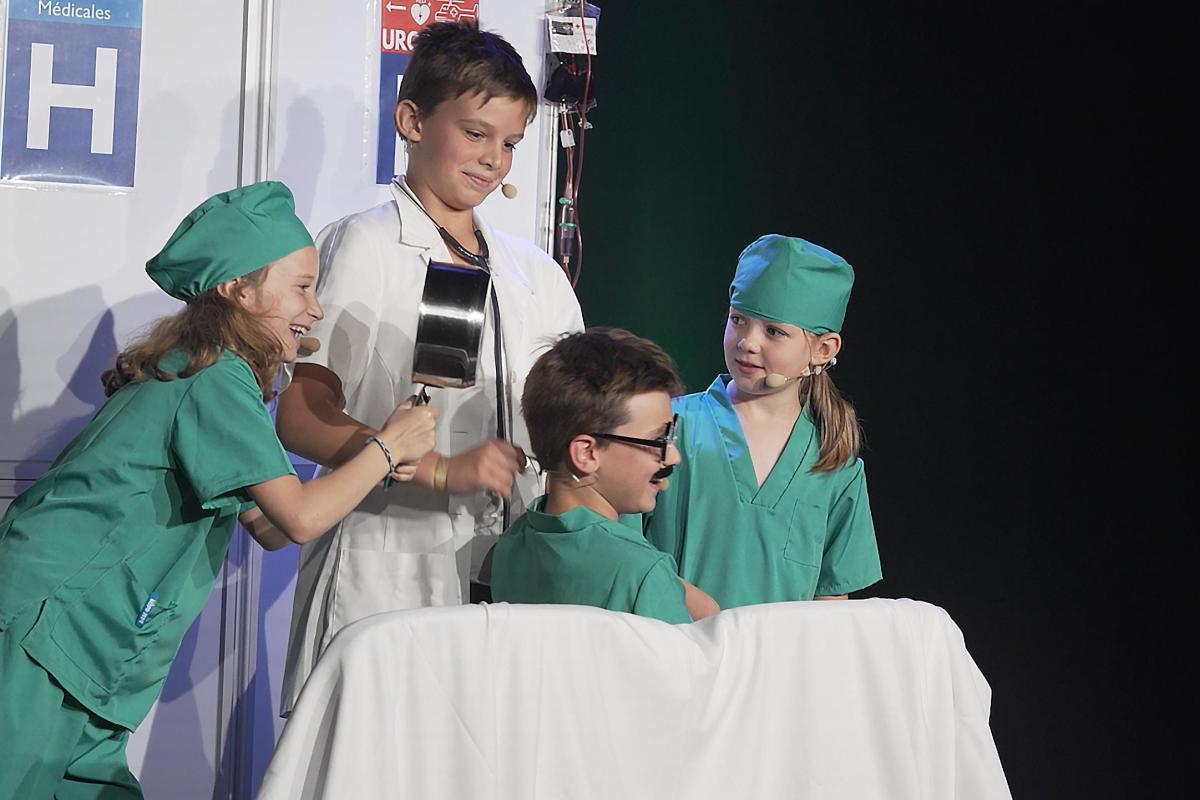
The end of the year culminates with the performance. It is a moment strong in emotions for the children as well as for the parents. Getting on stage, facing the benevolent gaze of the audience, is an unforgettable victory over oneself. The adrenaline, the wings, the applause: all this forges imperishable memories and boosts self-esteem in a spectacular way. It is the reward for collective and individual work led with passion.
Testing before committing: Camps
If doubt persists, why not take advantage of the school holidays? Intensive camps (summer, autumn, Easter) are formidable laboratories. In one week, your child can fully immerse themselves in the artistic universe. It is often during these camps that a vocation is revealed or that the choice between script and improv is refined. For families in Morges, it is a flexible solution to test our school's approach and meet the instructors before an annual registration.
Conclusion: Offering a Space of Freedom
In the end, whether you choose the creative rigour of the script or the gentle madness of improvisation, the essential lies elsewhere. By enrolling your child in a theatre class near Morges, you offer them much more than an activity: you offer them a space of freedom. A place where they can put down their school bag and their worries to simply be themselves, or someone else.
Dramatic art is a school of life that teaches listening, respect, and the management of emotions. These skills will accompany them well after the spotlights have gone out, making them a more open and confident human being. So, listen to your heart, observe your child, and dare to take the step. The stage is ready, it is only missing them for the magic to operate.
Our structure, Apolline Ecole d'Arts, accompanies these discoveries through its theatre and musical theatre classes located in Etoy, Lausanne, and Yverdon, welcoming young talents from 6 years old to help them grow through art.