Awakening the Senses in Geneva: Rediscovering the City Through Drawing in 2026
At the start of 2026, a desire to slow down and reconnect with reality is being felt in the streets of Geneva. Far from screens, many city dwellers are rediscovering the simple pleasure of observing the world with a pencil in hand. Learning to capture the essence of a landscape or a scene of life is not just a technical activity; it is a true active meditation. Whether you are parents seeking to awaken your children to beauty or adults in search of escape, the City of Calvin offers an exceptional playground for practicing drawing and painting.
Settling down to create outdoors transforms our view of the city. However, moving from observation to creation requires patience and a good guide. While guidance in a school remains fundamental for mastering the basics, personal exploration in a park or an alleyway is an indispensable complement to your learning. It is here that your skills are refined, confronted with changing light and urban life. We have selected inspiring places for you to set up your nomadic studio, adapted to every level, from the complete beginner to the enlightened amateur.
Green Sanctuaries: Ideal for Watercolor and Relaxation
To get started without pressure, nothing beats the calm of nature. Genevan green spaces are perfect for deploying your colors and daring your first strokes, far from the sometimes intimidating gaze of the crowd.
The Botanical Garden: A Lesson in Colors
A true open-air museum, the Botanical Garden is an inexhaustible source of inspiration for working on naturalist illustration. The plant diversity allows for the study of textures and the infinite nuances of colors. It is a particularly educational place for children, who can link scientific observation with artistic expression. To capture the delicacy of petals or the light filtering through leaves, watercolor is the queen of techniques. Fluid and light, it captures transparency with unique poetry.
The pedagogical advantage of this place is its stability: the plants pose patiently for you. It is the dream spot to practice mixing hues and managing water on paper. If you prefer a more covering material, acrylic allows for working in layers and correcting mistakes more easily, a reassuring asset for those beginning their journey in the arts.
Parc de la Grange: Space and Perspective
Offering a breathtaking view of the lake, Parc de la Grange invites contemplation. It is the ideal space to bring out an easel and try your hand at more ambitious formats. Here, one learns to manage successive planes: the grass in the foreground, the trees, then the lake and the sky. This work on composition is often addressed in courses, but experiencing it face-to-face with reality anchors the understanding of depth sustainably.
During the holidays, the park comes alive, offering sketchers the opportunity to capture living scenes. Attempting to seize the movement of a child running or a dog playing is an excellent exercise for developing execution speed. Although oil painting is traditional for landscapes, it requires heavy logistics; for an outdoor session, favor more nomadic mediums to keep the pleasure of spontaneity.
The Historic and Urban Heart: Challenges for Illustration and Manga
When you feel ready to tackle more complex subjects, the center of Geneva offers stimulating architectural challenges. It is here that the rigor of the line and the understanding of perspective become crucial.
The Old Town: The School of Rigor
The cobblestone streets and ancient facades of the Old Town are a school of high standards. Drawing St. Peter's Cathedral requires understanding how vanishing lines construct the illusion of 3D. It is an intellectual exercise as much as an artistic one, often dreaded but incredibly formative. For Manga enthusiasts, these settings rich in historical details constitute a fantastic image bank for creating immersive backgrounds.
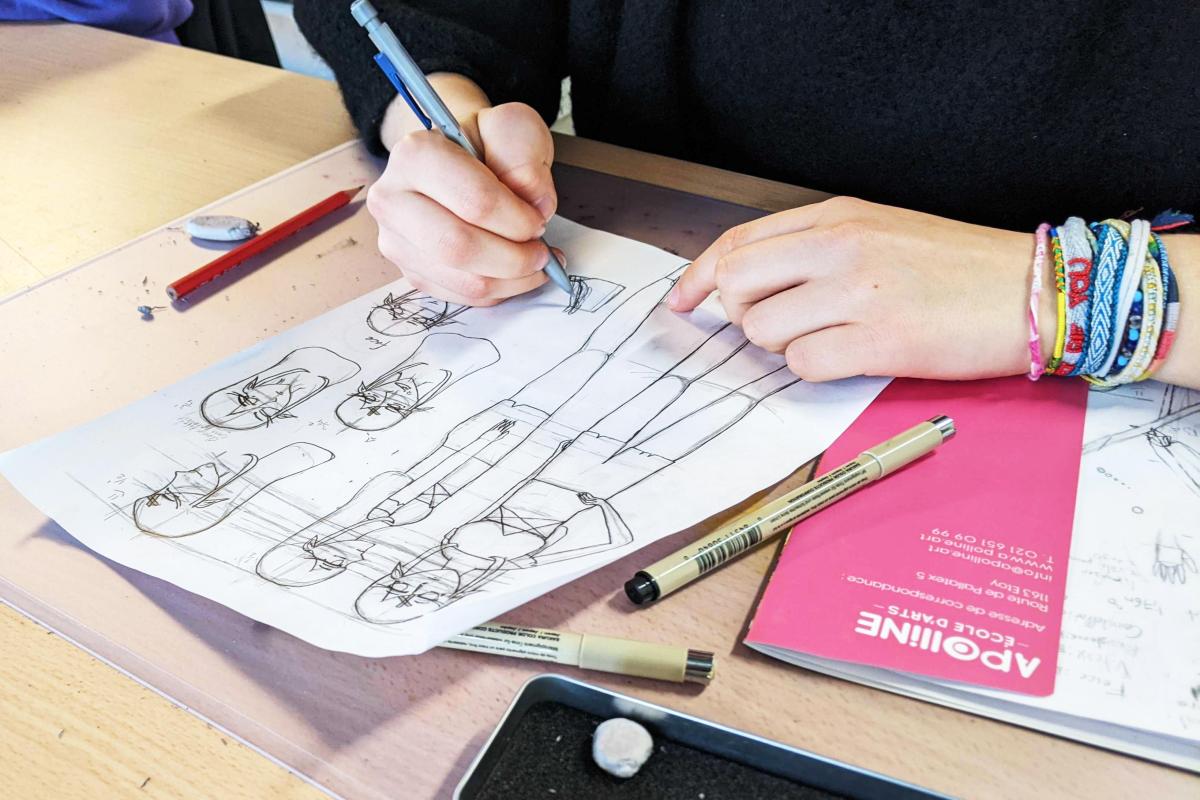
In this mineral environment, the graphite pencil or fine felt-tip pen are your best allies. They allow for a precision that the brush offers with difficulty on small formats. Working here teaches you to select the essential: you cannot draw everything; you must choose the strokes that tell the story. This is a skill that any good teacher will strive to transmit to you.
The Quartier des Bains: Modernity and Graphic Art
For a more contemporary approach, the Quartier des Bains and its industrial allure offer strong contrasts. The interplay of shadow and light is sharp, perfect for quick and expressive sketches. It is a place that often inspires adults seeking to develop a more personal, less academic style.
Daring to draw in the city also means accepting being seen. This is part of the work on self-confidence. At the beginning, one hesitates, hides their notebook, but with practice, one learns to isolate oneself in a creative bubble. It is a victory over oneself as important as technical mastery.
Nomadic Art: Choosing Your Material with Care
The success of an artistic outing depends greatly on the preparation of your bag. Unlike the comfort of home or a well-equipped classroom, the outdoors imposes constraints. You must travel light while having the necessities to express yourself.
The choice of the medium of expression is personal. A travel sketchbook with thick paper (about 300g) is indispensable if you use water (watercolor or inks). For dry sketching, a finer grain will suffice. Having a small kit with the essentials — a few pencils of different hardnesses, a kneaded eraser, a water brush pen — allows you to be ready to capture the moment at any time. This forced minimalism is pedagogical: it forces you to concentrate on the subject rather than on the tool.
Do not forget comfort: a small folding seat can save your session. As experienced artists often repeat during a workshop, one only draws well if one is seated well.
From Outdoors to Studio: The Importance of Training
While solitary practice is enriching, it has its limits. One can quickly feel frustrated facing a perspective that "doesn't look right" or a color that becomes muddy. It is at this precise moment that structured teaching makes perfect sense. Joining a weekly course allows you to unlock these situations.
In a studio, a qualified teacher casts a benevolent but expert eye on your production. They give you the theoretical keys — anatomy, color theory, composition — that you may lack intuitively. This alternation between free experimentation outside and rigorous study in a school is the secret to rapid and solid progression. Learning is a constant dialogue between theory and emotion.
Moreover, the group dynamics in collective courses are irreplaceable. Seeing how others solve the same plastic problems nourishes your own creativity. It is a place of exciting exchange and sharing for the child as well as the adult.
Key Information: Organizing for a Creative Year
For those who wish to structure their approach, it is useful to know how training works in Geneva. The offer is vast, and choosing the right orientation is the first step to your success.
In terms of investment, a quality course reflects the expertise of the teachers and the infrastructure. In 2026, generally count starting from 79 CHF per month for weekly monitoring. It is a commitment over the school year that guarantees constant evolution. For those who have less time, camps during the holidays are an intense and effective alternative. Often offered around 290 CHF per week, they allow for total immersion, ideal for discovering a new technique like oil painting or character design.
Before enrolling, consult the reviews and visit the premises if possible. A good arts school must make you feel welcome. Whether for playful workshops for the youngest or technical sessions for the grown-ups, the goal remains the same: personal fulfillment. Apolline Ecole d'Arts offers, for example, this benevolent guidance through its drawing and painting courses available in Geneva and throughout French-speaking Switzerland.
In conclusion, Geneva is a permanent invitation to creation. Whether you are shy with your pencil or already confident, the city offers you its lights and shadows. It is up to you to capture them. The important thing is not to make a masterpiece on every page, but to take pleasure in the act of doing. So, go out, observe, and let your hand dance on the paper.