The Importance of the Human Touch in Artistic Creation in 2026
It is January 2026. This year marks a technological turning point where artificial intelligence generates images in a fraction of a second. Faced with this revolution, a question often arises among parents and art lovers: why sign up for a drawing course today? The answer touches our very essence. Learning to draw has never been so crucial to preserving our humanity. It is not a rejection of technology, but an affirmation of our sensitivity.
In our school, we observe every day that artistic practice offers much more than a simple visual result. For children as well as adults, holding a pencil is an act of grounding. As the virtual world accelerates, taking the time for observation and manual gesture becomes a necessary refuge. It is a powerful way to reconnect with oneself and the real world.
Beyond the Screen: Cognitive Benefits for the Child
Learning drawing plays a fundamental role in brain development, far beyond simple recreation. For a child, the effort of coordination between eye and hand stimulates neuronal zones that sliding a finger on a tablet does not solicit. This precision work strengthens concentration, a quality that has become rare but essential for school success.
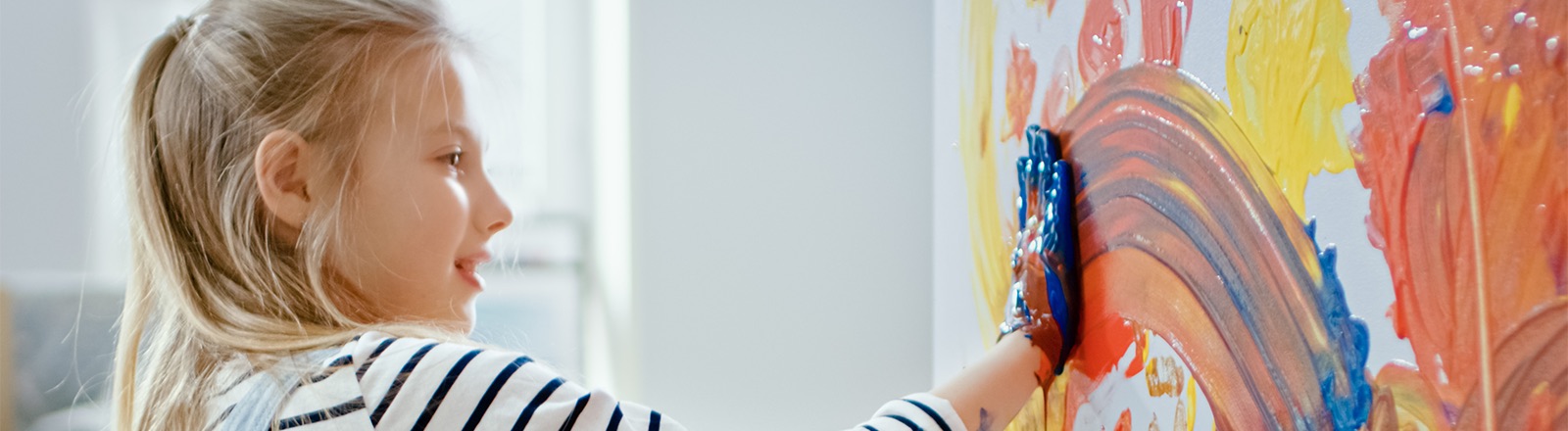
Artistic education teaches patience and resilience. When a student erases, corrects, and starts over, they learn that error is part of the process. These transferable skills are precious for their future. Moreover, from the youngest age, even for a baby exploring marks, these awakening activities promote indispensable fine motor skills. Our courses for the youngest do not aim for performance, but the global fulfillment of the child through sensory discovery.
The Magic of Materials: Paint, Oil, and Charcoal
There is a particular emotion in smelling the scent of paint or feeling the grain of paper under the fingers. It is a sensory experience that digital cannot offer. In a workshop, one gets their hands dirty, mixes colors, feels the material. Watercolor, with its unpredictable water effects, teaches letting go. Oil, unctuous and slow to dry, invites meditation and progressive construction.
Mastering these techniques requires time and sensitivity. The tracing of a line in charcoal bears the unique signature of the one who draws it; it reveals a part of their soul. Acrylic allows for a more direct and spontaneous expression. Each technique is a different language. In our courses, we encourage students, from the beginner to the initiate, to explore these mediums to find the one that makes their sensitive chord vibrate. Manual illustration keeps this organic vibration, this magnificent "imperfection" that touches the heart.
Manga and Creativity: Telling Your Own Story
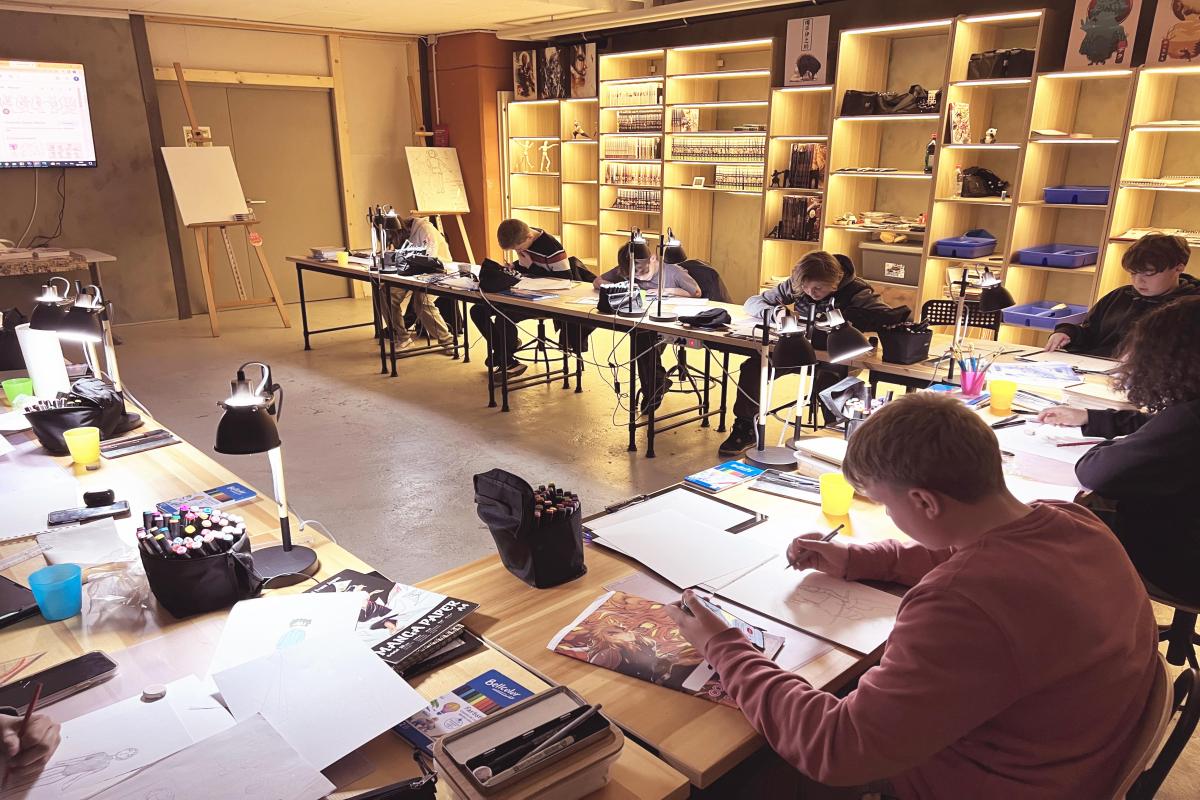
Manga remains a devouring passion for the youth of 2026. If AI can generate a standardized character, it does not possess the lived experience necessary to breathe a soul into a story. It is here that human creativity shines. In a manga course, adolescents do not only learn to copy eyes or hair; they learn to give life to their emotions.
A good teacher is not content to simply show how to draw; they guide the student to develop their own style. They help them structure their narrative and express complex feelings. For young people aiming for entrance exams in higher arts schools, this authenticity is key. A portfolio filled with generated images will never have the value of a sketchbook testifying to personal research and an affirmed style. It is the difference between a consumer of images and a true artistic creator.
The Power of the Group: The Workshop as a Social Space
Learning alone at home can be practical, but nothing replaces the energy of a group. The workshop is a space for sharing and kindness. In Geneva as elsewhere in French-speaking Switzerland, our creation spaces become intergenerational meeting places. We see budding artists exchanging tips, inspiring each other, and progressing together.
Art creates bonds. We often see duos forming: a couple looking for a common activity, or a family coming to share a moment of complicity far from screens. These workshops break isolation. Face-to-face teaching allows for immediate correction of the gesture by the teacher, but also precious moral support. Intensive camps during the holidays reinforce this dynamic. During a camp, immersion is total, allowing for crossing important technical thresholds while weaving lasting friendships.
Choosing Your Artistic Education: Tips for 2026
Faced with the multitude of offers, choosing the right course or the right school is essential to progress. It is important to find an environment that respects your rhythm and aspirations. Whether you are looking for a relaxing hobby or rigorous academic training, the quality of teaching is paramount.
Here are some tracks to guide you this year:
- Check the levels: A good school offers adapted groups, from total beginner to advanced profiles, so that everyone finds their place without pressure.
- Diversity of techniques: Ensure that the program covers a wide spectrum, from modern illustration to classical bases, to enrich your practice.
- The pedagogical approach: The teacher must be able to adapt their method to the personality of the student, whether it is a dreaming child or a methodical adult.
- Location: Regularity is key. Courses accessible near you, whether in Geneva or in other cities, facilitate attendance.
The Importance of Materials and Practice
Getting started requires a bit of materials, but it is an investment for the spirit. Having your own kit, choosing your papers, preparing your brushes: these rituals are part of the pleasure. They mark a break with daily life. No need for expensive equipment to start; a simple pencil and paper suffice for the first lessons.
It is through repetition that ease arrives. Visual arts require regular practice. Weekly workshops offer this structuring framework, but drawing a little every day at home strengthens the acquisitions. It is a means of expression that grows with you. The skills acquired by drawing – observation, patience, sensitivity – enrich all aspects of life.
Conclusion: Cultivating Your Secret Garden
Ultimately, learning drawing or painting in 2026 is a gift one gives to oneself. It is choosing to remain an actor of one's vision of the world. Machines can produce, but only humans can create with intention and emotion. The courses we propose are spaces of freedom where every year, hundreds of students discover their potential.
Whether for the development of your children, to prepare for exams, or simply for the pleasure of creating, the door of the school is open. Join us to explore your talents, whether during our creative holidays, in a discovery camp or via our regular courses. Leave your mark on the paper, it is the unique proof of your passage and your sensitivity. At Apolline Ecole d'Arts, we believe that every line counts.