Two days, twenty-two of us, two hundred students, and a six-year-old niece
By Cédric Maillard, co-founder, director and teacher at Apolline
Seven in the morning, Saturday 20 June. It has been a scorching June, and early as it is, the heat is already there. We sweat as we unload the instruments outside the Ateliers de la Côte in Etoy, still empty.
There are stages to build, sets to put up, cables to run and sound to test, and then the dress rehearsals to get through. The audience at Apolline Fest will see none of that day. It is still half the work.
The following morning, Sunday, we are all on site by eight.
8am: the stage we give them before the show
The first students turn up long before the doors open. Here, a music student walks on stage once in the morning for a trial run before the real concert at eleven, whether they come from our singing lessons, from piano, from guitar or from drums. A precious hour in a very full day, and an essential one. A child who has already felt the boards underfoot walks back on them taller, and surer.
While we greet the students, their parents and their families, the music teachers settle in on stage. That is how we do things here: they accompany their students.
At eleven, I sat down for the first time since the day before.
People tend to assume that on the day of a show the nerves belong to the children. There is ours too. We know they have them, and that is why ours are worse. A whole year of work comes down to a few minutes. You want so badly for it to go well for them. And at that moment, the stage is entirely theirs. I think every one of my teaching colleagues would tell you the same. That kind of stage fright, we share.
12:45: an hour to turn the stage around
Between 12:45 and 1:45, the audience may well have thought we were having lunch.
We would have loved to be. In fact the stage was changing face. A music concert leaves a considerable amount of equipment behind, and all of it has to come down at speed. The theatre set then has to go up, the actors have to arrive early enough to find their marks, and the room has to be handed back to the audience at the time announced. One hour, timed to the minute.
2pm: “They blew me away”
The afternoon belonged to two companies from our theatre classes. Yverdon played Jean-Claude, Etoy L’Affaire Poliakoff, close to fifty minutes each. Two full plays, held from beginning to end. I stayed for both. This is the kind of show you pay to see.
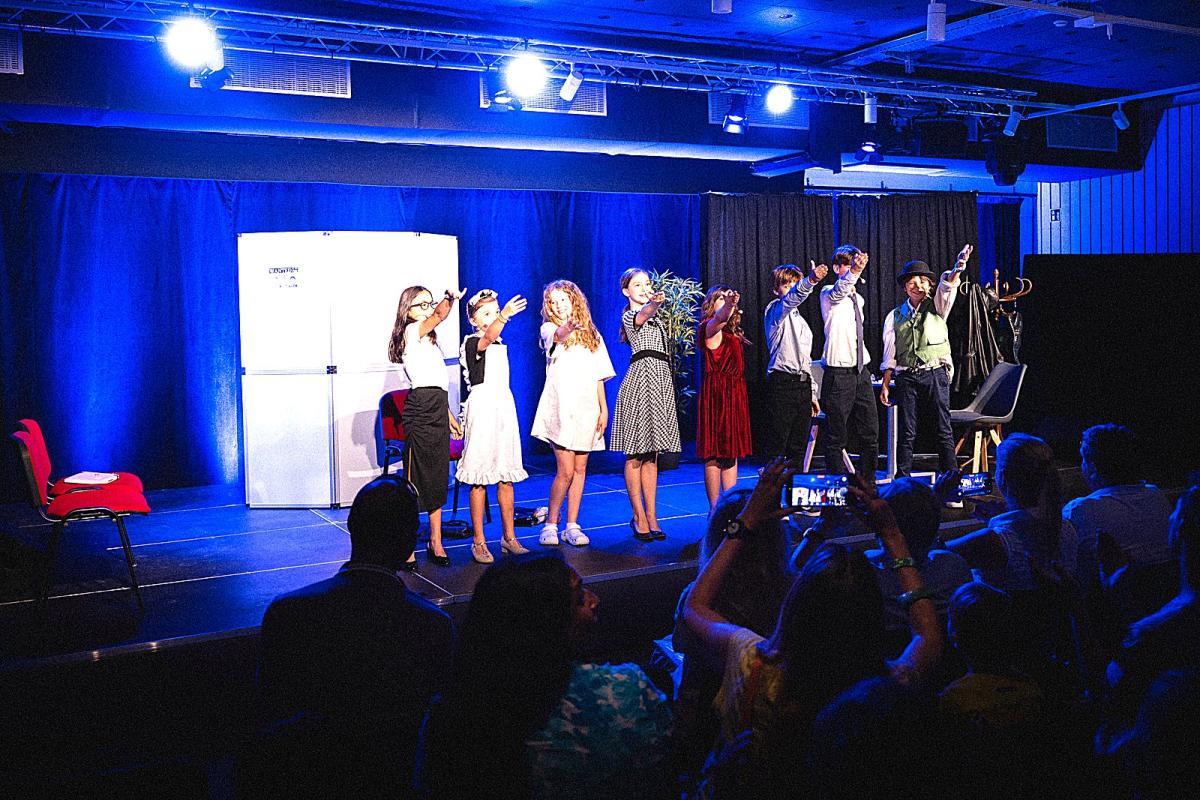
The cast taking their bow, at the end of the afternoon.
Mirko Rochat, who directed them and worked with them all year, came to find me after the performance. He summed it up in a single phrase: “They blew me away.” We agreed.
4:30pm: Olympe is six, and she is my niece
I may as well say it plainly. Olympe is my niece, she is six, and on 21 June she walked onto a stage for the first time in her life. That moment, I did not live through as the director.
Back in September we had hesitated to enrol her in musical theatre. On paper she was too young. A date of birth says little, though, about what a child wants and what they are ready for. We put her in the room, with Melie, in our musical theatre class in Lausanne. Then we watched how it went, week after week. She found her place.
I was sitting in the audience, on the right, towards the back, in a full house. I watched her come out onto the stage with a broad smile that moved me.
But what stayed with me most was what she had gained between September and June. It took me a while to find the right word for it. Independence. Not confidence: independence.
When I asked her what she had made of her day, she put it her own way: “I loved it, and Melie’s really nice.”
6pm: thirty children on stage at once
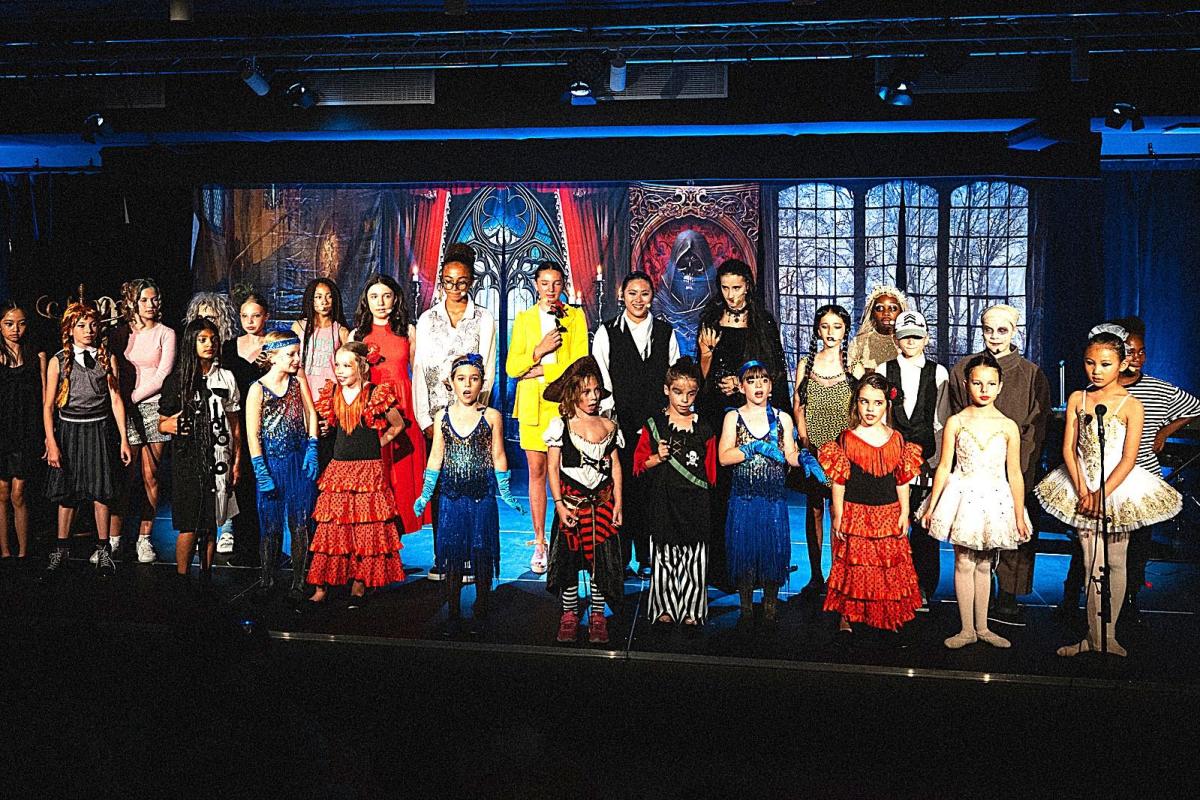
Melie, as it happens. For the first time, musical theatre brought some thirty students together at once, around The Addams Family, with her and the Lausanne group. Thirty children in costume and make-up holding a show from start to finish is an achievement. It is also a demanding machine to run.
Our backstage reached its limit, and it showed: this production was a good deal more rock’n’roll than the ones before it. A day like this one concentrates in a single place what the school does over a whole year. There were twenty-two of us running it: fourteen teachers, six volunteers, one colleague from the office and myself. For more than two hundred students on stage or exhibiting, and for their families. It is the first job on the list for the next edition.
After the festival: things to improve
The exhibition from our visual arts classes deserves a better setting than the one we gave it.
The work went up at ten in the morning and stayed in place all day. Late in the afternoon someone photographed the pieces one by one for a quarter of an hour. Fifty-one images: a koala hugging a football, an outrigger canoe run aground on a beach, two camels in the dunes, a portrait in profile. There was plenty there worth stopping for. It is up to us to bring more people in front of what the students make over the year.
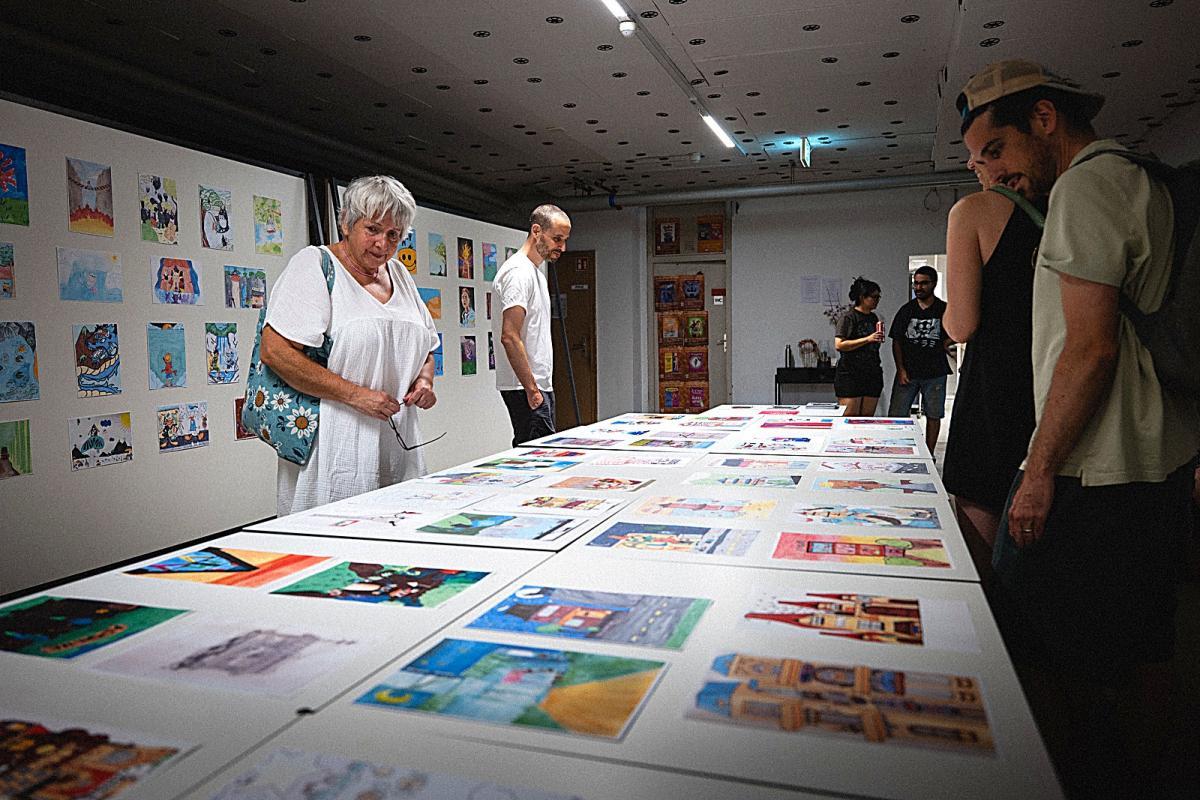
The exhibition, laid out on the tables and along the walls, late in the afternoon.
The work was there, and so were the teachers. It is the format that has to change, and the format is our business. An exhibition begins where the hanging leaves off. What we are after is for a student to find themselves in the position of an artist showing work: choosing the pieces, hanging them, being able to tell someone what they were trying to do. We are going to take this up again with the visual arts teachers, and the students will be part of it.
That is the thing I work hardest at these days: putting our real difficulties to the whole teaching team. Not the presentable ones, the real ones. The answers that come out of it are sounder, and above all they are the ones the teachers carry themselves.
September: a year to consolidate
Over the 2025–2026 school year we worked with more than five hundred students every week and welcomed over a thousand children to our holiday courses. In September we made a choice: to spend this year strengthening what we already do, without opening a new location or adding a new discipline. The quality of the teaching comes first.
There is something new all the same, and it comes in the form of people. Vaïna, Richard and Violette are joining visual arts; Mathieu is back in music after a year away, alongside Anatole and Aleksandra.
Next year, we will start again the day before, at seven in the morning.